Section 2.3 The Unit Circle and Trigonometric Functions

Definition 2.3.1.

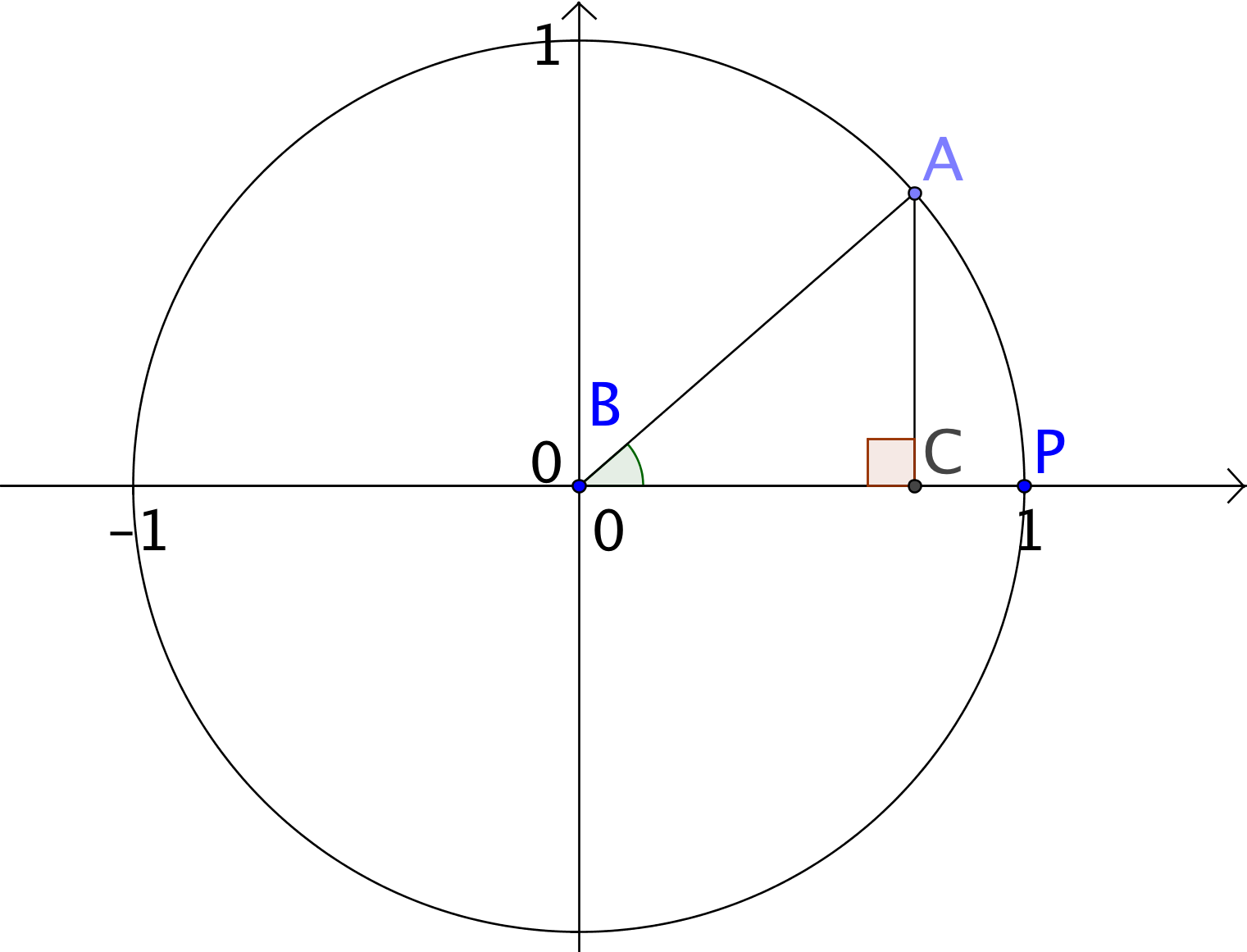
Alternate definition for trigonometric functions. In Figureย 2.3.2, notice that since point \(A\) is on the unit circle, \(AB=1\text{.}\) Also, if \(A\) has coordinates \((x,y)\text{,}\) then \(BC=x\text{,}\) and \(AC=y\text{.}\) Use this information to rewrite \(\sin \theta\text{,}\) \(\cos \theta\text{,}\) and \(\tan \theta\) in terms of \(x\) and \(y\text{.}\) We can now define the three trigonometric functions for any angle \(\theta\) by measuring \(\theta\) as the angle (in radians) traversed counterclockwise from the positive \(x\)-axis.
The unit circle with a triangle in the first quadrant. The point B on the triangle is at the origin, the point A on the triangle is on the unit circle and the point C on the triangle is on the x-axis. The line AC is perpendicular to x-axis.
Figure 2.3.2.
Next, we will see how we can use special triangles and coordinates on the Unit Circle to compile a table of values of sine and cosine of commonly used angles.

Investigation 2.3.1.

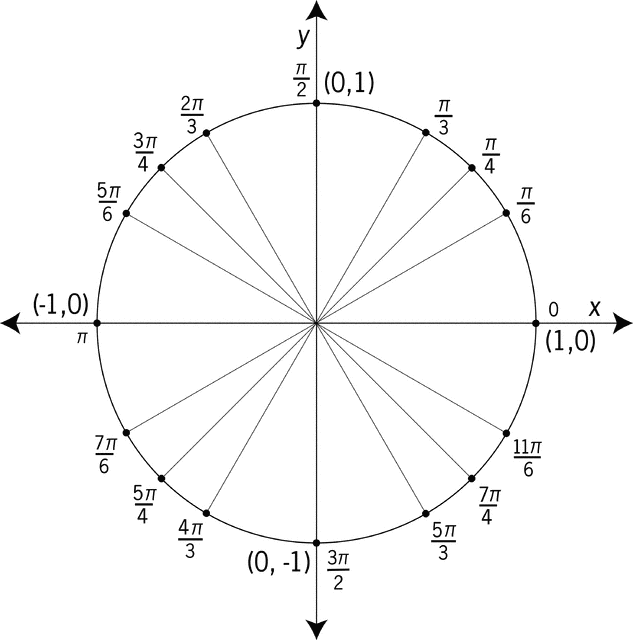
First, use the unit circle Figureย 2.3.4 to find the sine, cosine and tangent of 0, \(\frac{\pi}{2}\text{,}\) \(\pi\text{,}\) \(\frac{3 \pi}{2}\text{,}\) \(2\pi\) and record your answers in Tableย 2.3.5.
A unit circle centered at the origin on an xโ€“y coordinate plane. The positive x-axis points to the right and the positive y-axis points upward. Points on the circle are labeled with common radian measures, including 0 at (1,0), pi over two at (0,1), pi at (-1,0), and three pi over two at (0,-1), along with pi over six, pi over four, pi over three, five pi over six, and their corresponding angles in the other quadrants.
Figure 2.3.4.
Table 2.3.5. Trigonometric Values for Common Angles
\(\alpha\) \(\sin \alpha\) \(\cos \alpha\) \(\tan \alpha\)
\(0\) ________ ________ ________
\(\frac{\pi}{6}\) ________ ________ ________
\(\frac{\pi}{4}\) ________ ________ ________
\(\frac{\pi}{3}\) ________ ________ ________
\(\frac{\pi}{2}\) ________ ________ ________
\(\frac{2\pi}{3}\) ________ ________ ________
\(\frac{3\pi}{4}\) ________ ________ ________
\(\frac{5\pi}{6}\) ________ ________ ________
\(\pi\) ________ ________ ________
\(\frac{7\pi}{6}\) ________ ________ ________
\(\frac{5\pi}{4}\) ________ ________ ________
\(\frac{4\pi}{3}\) ________ ________ ________
\(\frac{3\pi}{2}\) ________ ________ ________
\(\frac{5\pi}{3}\) ________ ________ ________
\(\frac{7\pi}{4}\) ________ ________ ________
\(\frac{11\pi}{6}\) ________ ________ ________
\(2\pi\) ________ ________ ________

Remark 2.3.6.

Perhaps because the ancient Greeks did a lot of geometry, it is common to use Greek letters in geometry, especially to label angles. In this case, the letters used are \(\alpha\) (alpha), \(\beta\) (beta), and \(\theta\) (theta). Also, recall that in a right triangle, we have that for any angle \(\phi\) (pronounced โ€œfee") the definitions \(\sin \phi = \frac{opposite}{hypotenuse}\text{,}\) \(\cos \phi =\frac{adjacent}{hypotenuse}\text{,}\) and \(\tan \phi = \frac{opposite}{adjacent}\) (the acronym to remember these is SOHCAHTOA).

Problem 2.3.7.

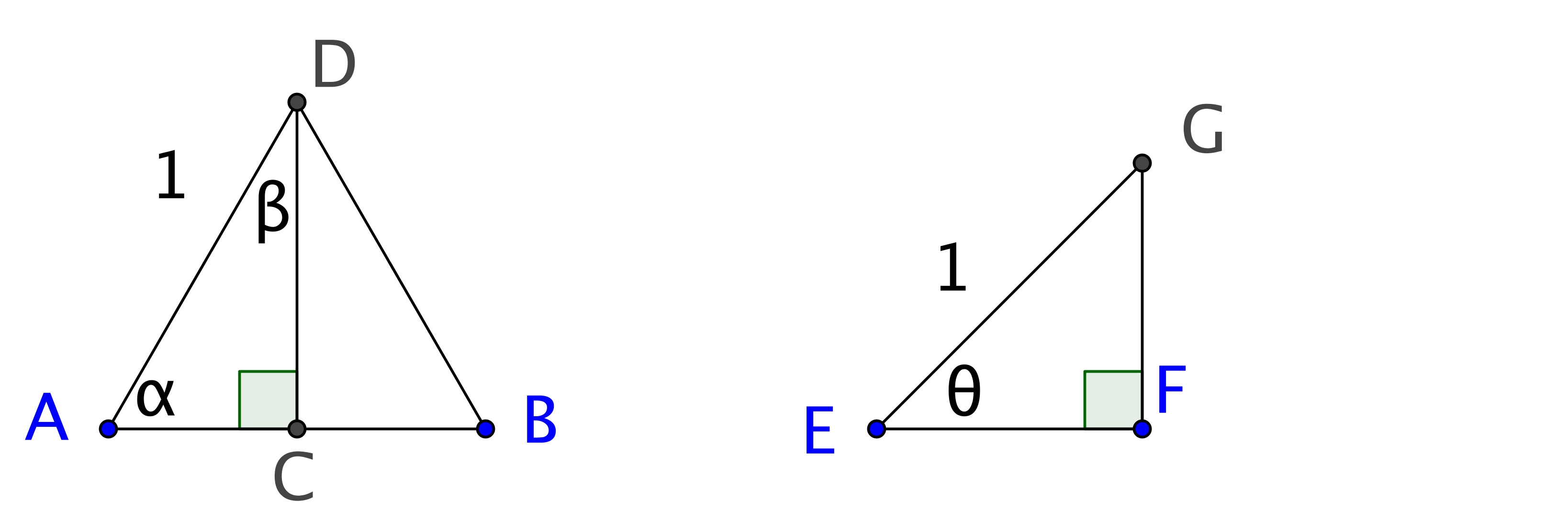
In Figureย 2.3.8, \(\triangle ABD\) is an equilateral triangle with sides of length 1. Point \(C\) is the midpoint of \(\overline{AB}\text{.}\) Recall that the sum of the angles in a triangle is \(180^o\text{,}\) and that \(360^o\) is the same as \(2\pi\) radians. \(\triangle EFG\) is an isosceles right triangle, meaning that the two legs of the triangle are equal in length.
Two separate right triangles are shown side by side. In the left triangle, points A and B lie on a horizontal base with point C between them, forming a right angle at C. Point D is above C, forming two slanted sides from A to D and from D to B. The side from A to D is labeled 1. Angle at A is labeled alpha, and the angle at D between the left slanted side and the vertical segment is labeled beta. In the right triangle, points E and F lie on a horizontal base with a right angle at F, and point G is above F. The slanted side from E to G is labeled 1, and the angle at E is labeled theta.
Figure 2.3.8.
  1. Find the measure of \(\alpha\) and \(\beta\) in radians.
  2. Find the the length of \(AC\) and \(CD\text{.}\)
  3. Compute \(\sin \alpha\text{,}\) \(\cos \alpha\text{,}\) \(\tan \alpha\text{.}\)
  4. Compute \(\sin \beta\text{,}\) \(\cos \beta\text{,}\) \(\tan \beta\text{.}\)
  5. What is the measure of \(\theta\) in radians? (Notice that there are two equal angles in \(\triangle EFG\text{.}\))
  6. Find the length of \(EF\) and \(FG\text{?}\)
  7. Compute \(\sin \theta\text{,}\) \(\cos \theta\text{,}\) \(\tan \theta\text{.}\)

Problem 2.3.9.

Use the two triangles above and the Unit Circle to determine the sine, cosine and tangent of the remaining angles in Tableย 2.3.5. Record your answers in the table.

Remark 2.3.10.

While it is common to see the right triangle definitions for the trigonometric functions first, in practice, mathematicians often think of the equations in Definitionย 2.3.1 as the definition of the trig functions. The equations in Definitionย 2.3.1 lead to being able to graph the trigonometric functions for values beyond those in a right triangle, and later will be useful for modeling the motion of an object moving around in a circle.

Investigation 2.3.2.

At the url http://tinyurl.com/153sincos you will find an animation in Desmos that shows how the graphs of the sine and cosine function can be seen as functions with the angle with the \(x\)-axis as the input, and the coordinates of the point on the unit circle as the output.
  1. Turn on the sine animation by clicking the circle next to โ€™Sine Animationโ€™. Note how the graph of the sine function is traced out, with its values equal to the y-coordinate of points on the unit circle as the value of \(\alpha\) changes. Sketch the graph of \(f(x)=sin(x)\text{.}\)
    A graph drawn on an xโ€“y coordinate grid. The x-axis and y-axis intersect at the origin and are marked with evenly spaced grid lines. A single function is shown using a bold curve or line against the grid, with the surrounding grid extending in all directions to provide scale and reference.
    Figure 2.3.11.
  2. Turn off the sine animation by clicking the circle next to โ€™Sine Animationโ€™. Turn on the cosine animation by clicking the circle next to โ€™Cosine Animationโ€™. Note how the graph of the cosine function is traced out, with its values equal to the x-coordinate of points on the unit circle as the value of \(\alpha\) changes. Sketch the graph of \(f(x)=cos(x)\text{.}\)
    A graph drawn on an xโ€“y coordinate grid. The x-axis and y-axis intersect at the origin and are marked with evenly spaced grid lines. A single function is shown using a bold curve or line against the grid, with the surrounding grid extending in all directions to provide scale and reference.
    Figure 2.3.12.

Problem 2.3.13.

A Ferris wheel has a diameter of 24 feet, and is mounted so that the bottom of the wheel is 6 feet off the ground. The ride turns counterclockwise as seen by the operator.
  1. Draw a diagram of the Ferris wheel in the xy-plane.
  2. Write an equation to describe the points on the Ferris wheel.
  3. Samโ€™s ride gets stopped when the angle from the horizontal to his car is \(\frac{\pi}{2}\text{.}\) What are his coordinates?
  4. At the same time, Sylviaโ€™s car is located at an angle of of \(\frac{5 \pi}{6}\) from the horizontal. What are her coordinates?
  5. At the same time, Steveโ€™s car is located at \((0, 6)\text{.}\) What is the angle from the horizontal to his car?