
Subsection 1.4 Rational Functions Exercises

  1. Refer to \(A(x)=\frac{4x+5}{2x-4}\text{.}\)
    1. What is the domain of \(A\text{?}\)
    2. Graph \(A(x)\) so that the important features are visible, and label them.
    3. Let \(B(x)\) be the function whose graph is a shift of \(A(x)\) down 3 units, and to the right 5 units. Write \(B(x)\) as a transformation in terms of \(A(x)\text{,}\) and then use that to get an algebraic formula for \(B(x)\text{.}\)
  2. Refer to \(T(x)=\frac{(x+1)^2}{x+1}\text{.}\)
    1. What is the domain of \(T\text{?}\)
    2. Graph \(T(x)\) so that the important features are visible, and label them.
    3. In Desmos, use the settings to view a table of values for \(T(x)\text{.}\) How is the domain reflected in the table?
    4. Is the graph what you expected? Explain.
  3. Refer to the function \(G(x)=\frac{2x+3}{(x+4)(x-2)}\text{.}\)
    1. Graph \(G(x)\) so that the important features are visible, and label them.
    2. What is the domain of \(G\text{?}\)
    3. On which interval(s) is \(G(x)\) decreasing?
    4. Let \(F(x)=G(x)-3\text{.}\) Graph \(F(x)\) and label its features.
  4. A toy rocket is launched vertically into the air from a height of \(h\) meters and with an initial upward velocity of \(v\) meters/second. The ball’s height above ground is given by the equation \(H(t)=-4.9t^2 + vt + h\text{,}\) where \(H\) is in meters and \(t\) is in seconds. (This is the metric version of the gravity model.)
    1. Write an equation to model the height of a rocket launched from a height of 2 meters off the ground, with an initial upward velocity of 25 meters/second.
    2. How long is the ball in the air?
    3. What is the maximum height reached by the ball? When does it reach this height?
    4. When is the rocket at a height of 10 meters?
    5. When is the rocket at a height of greater than 20 meters?
  5. Let \(a(x)=e^x\text{,}\) \(b(x)=e^{-x+2}\text{,}\) \(c(x)=\frac{1}{x^2}\text{.}\) Write a function equation for each function below, using the exponent rules to simplify the equation and write without negative exponents.
    1. \(\displaystyle k(x)=(c \circ b)(x)\)
    2. \(\displaystyle f(x)=c(x) \cdot a(x)\)
    3. \(\displaystyle g(x)=(b(x))^{-2}\)
    4. \(\displaystyle h(x)=2 \left( \frac{a(x)}{b(x)} \right)\)
    5. \(\displaystyle j(x)=a(x)\cdot b(x)\)
  6. Write as a single logarithm: \(2\log_5{x}-5\log_5{y-5}+\frac{1}{3}\log_5{z}\)
  7. Write as a sum and/or difference of logarithms: \(\ln \left(\frac{x^4y^3}{z^2}\right)\)
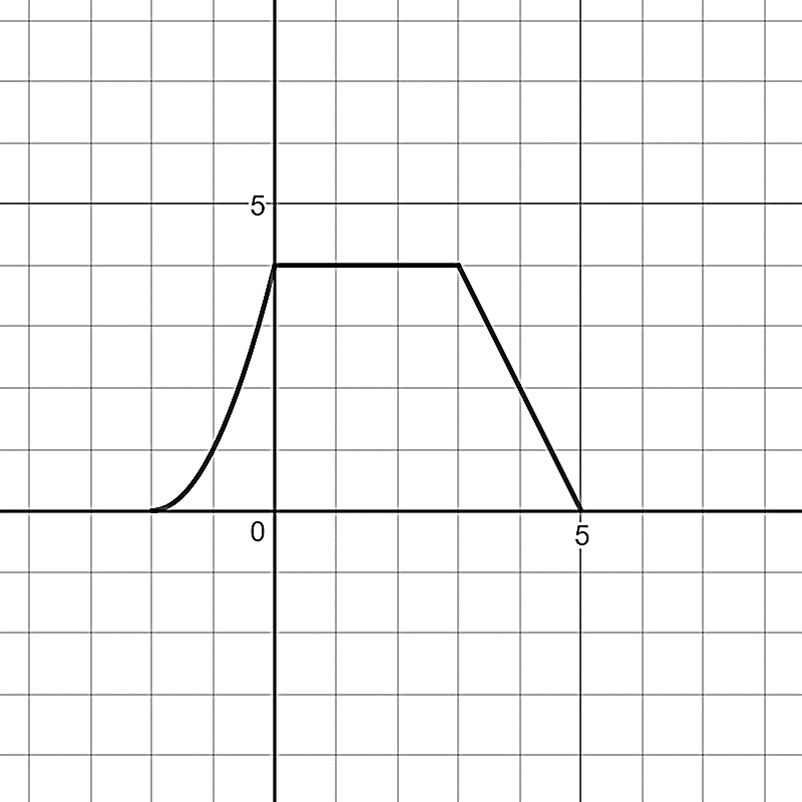
  8. Refer to the graph of \(f(x)\) in FigureΒ 1.4.12. Let \(g(x)=-f(x-3)+1\text{.}\)
    A graph showing a piecewise function on a coordinate grid. The curve starts at \((-2,0)\text{,}\) rises smoothly to \((0, 4)\text{,}\) then remains constant at \(y = 4\) until \(x = 3\text{.}\) After that, the graph decreases linearly to \((5, 0)\text{.}\) The visible grid shows x-values from about -2 to 6 and y-values from about -2 to 6.
    Figure 1.4.12. Graph of a piecewise-defined function.
    1. Describe the transformations that would be required to transform \(f(x)\) in to \(g(x)\text{.}\)
    2. On the same set of axes, sketch the graph of \(g(x)\text{.}\)
    3. What are the domain and range of \(f(x)\text{?}\)
    4. What are the domain and range of \(g(x)\text{?}\)

