Skip to main content
Contents Dark Mode Prev Up Next \(
\newcommand{\lt}{<}
\newcommand{\gt}{>}
\newcommand{\amp}{&}
\definecolor{fillinmathshade}{gray}{0.9}
\newcommand{\fillinmath}[1]{\mathchoice{\colorbox{fillinmathshade}{$\displaystyle \phantom{\,#1\,}$}}{\colorbox{fillinmathshade}{$\textstyle \phantom{\,#1\,}$}}{\colorbox{fillinmathshade}{$\scriptstyle \phantom{\,#1\,}$}}{\colorbox{fillinmathshade}{$\scriptscriptstyle\phantom{\,#1\,}$}}}
\)
Subsection 5.2 More Trigonometric Identities Exercises
Prove each trigonometric identity.
\(\displaystyle \frac{\sin x}{1-\cos (-x)}=\frac{1+ \cos (-x)}{\sin x}\)
\(\displaystyle \frac{\tan (-x)}{\sin (-x)}=\sec x\)
\(\displaystyle (2\cos^2x-1)^2+(2\cos x \sin x)^2=1\)
\(\displaystyle \sin (2x) = \frac{2 \tan x}{1+\tan^2x}\)
\(\displaystyle (\cos x - \sin x)^2 = 1 - \sin (2x)\)
\(\displaystyle (\cos x + \sin x)^2 = 1 + \sin (2x)\)
\(\displaystyle \csc (2x)-\cot(2x) = \tan x\)
\(\displaystyle \sin(\frac{\pi}{2}+x)=\cos x\)
\(\displaystyle \csc 2 \theta=\frac{\csc \theta}{2 \cos \theta}\)
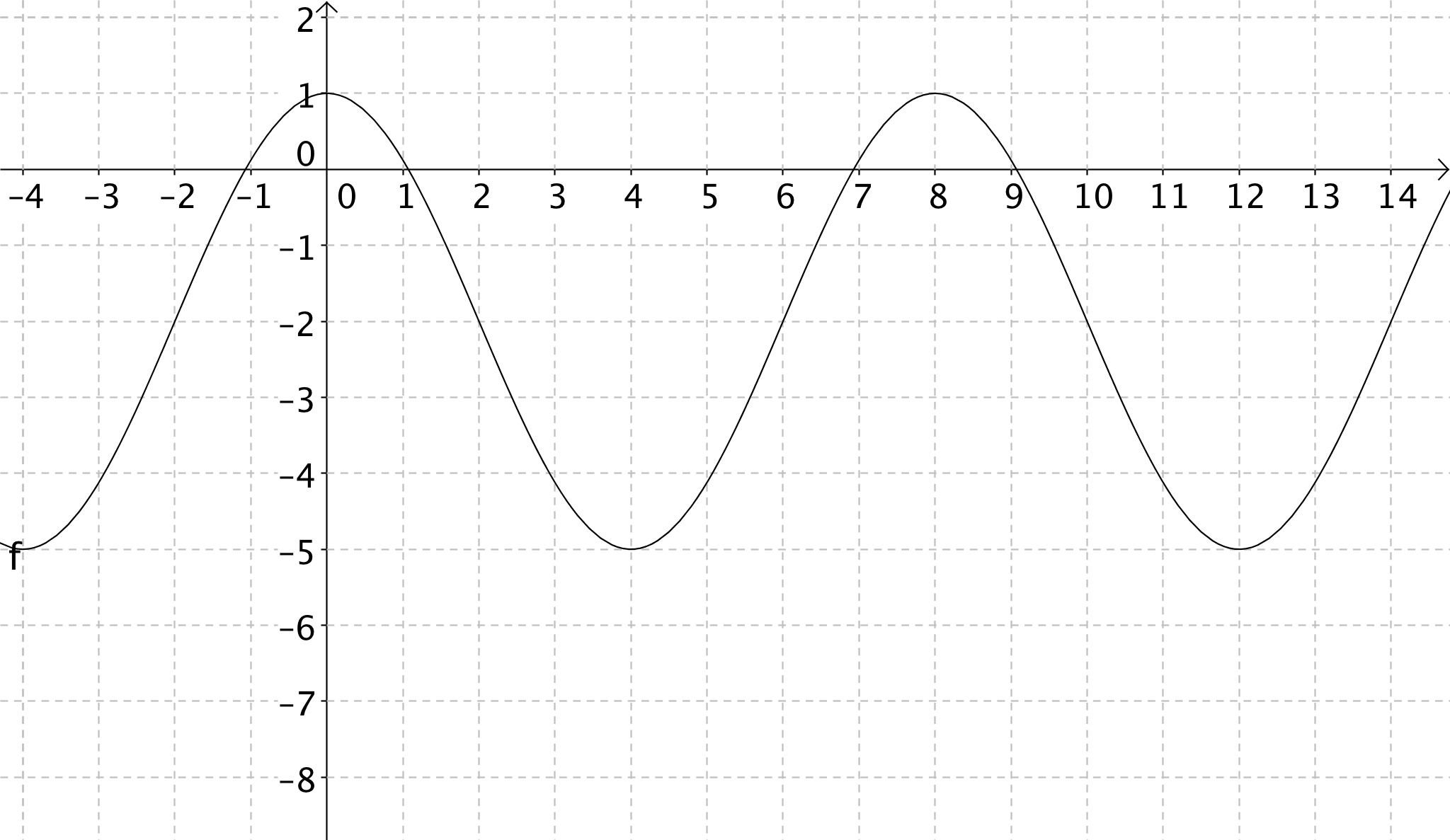
The graph of
\(f(x)\) is shown below. Let
\(g(x)=f(x-1)+3\text{.}\)
Figure 5.2.7.
Describe the transformations that would be required to transform
\(f(x)\) in to
\(g(x)\text{.}\)
On the same set of axes, sketch the graph of
\(g(x)\text{.}\)
What are the domain and range of
\(f(x)\text{.}\)
What are the domain and range of
\(g(x)\text{.}\)
Perform the indicated operation and simplify if possible.
\(\displaystyle \frac{s^2+2s-8}{2s^2-8}\)
\(\displaystyle \frac{b^2+5cb-6c^2}{2b^2} \cdot \frac{12b}{4b-4c}\)
\(\displaystyle \frac{5}{v}+\frac{3}{v-1}\)
For each angle
\(\theta\) below, find
\(\sin \theta\text{,}\) \(\cos \theta\text{,}\) \(\tan \theta\text{,}\) \(\sec \theta\text{,}\) \(\csc \theta\) and
\(\cot \theta\text{.}\)
\(\displaystyle \theta=-\frac{\pi}{2}\)
\(\displaystyle \theta=18\pi\)
\(\displaystyle \theta=-\frac{15 \pi}{4}\)
Suppose that in
\(\triangle ABC\text{,}\) \(m\angle B =\frac{3\pi}{5}\text{,}\) \(m\angle C = \frac{\pi}{18}\text{,}\) and
\(AC=10\text{.}\) Find the length
\(AB\text{.}\)
Let
\(z(t)=3 \cos (4t)\text{.}\)
On the domain
\(0 \leq t \leq 2\pi\text{,}\) list all intervals on which
\(z\) is decreasing.
What is the average rate of change of
\(z\) on the interval
\(\frac{\pi}{6} \leq t \leq \frac{\pi}{3}\text{?}\)
Find the inverse function
\(z^{-1}\) and state the domain and range of
\(z^{-1}\text{.}\)
A platform is in the shape of a circle, and has 12 wedge-shaped tiles of equal size. The circle has a radius of 8 feet.
What is the length of the arc along the edge of one tile?
Draw a diagram and impose coordinates so that the center of the circle is at
\((0,0)\text{,}\) and the edge of one tile lines up along the positive
\(x\) -axis.
A bug is crawling clockwise along the edge of the circle, and begins at the point
\((8,0)\text{.}\) Suppose he crawls at a rate of 1 foot/second. Write parametric equations for the bug’s position at time
\(t\) seconds after he begins his journey.
Write an equation for
\(f(x)\text{.}\)
Draw a graph of
\(f(2x)\) on the interval
\(0 \leq x \leq 12\text{.}\)
Refer to the function
\(a(x)=10e^x\text{.}\) Let
\(b(x)=4x+3\text{.}\)
Graph
\(a(x)\) on the domain
\(-2 \leq x \leq 5\text{.}\)
Solve
\(a(x) > 50\text{.}\)
Write a function equation for the inverse function,
\(a^{-1}(x)\text{.}\)
Let
\(c(x)=a(b(x))\text{.}\) Write a function equation for
\(c(x)\text{.}\)
Let
\(d(x)=a(x)+b(x)\text{.}\) Write a function equation for
\(d(x)\text{.}\)