Skip to main content
Contents Dark Mode Prev Up Next \(
\newcommand{\lt}{<}
\newcommand{\gt}{>}
\newcommand{\amp}{&}
\definecolor{fillinmathshade}{gray}{0.9}
\newcommand{\fillinmath}[1]{\mathchoice{\colorbox{fillinmathshade}{$\displaystyle \phantom{\,#1\,}$}}{\colorbox{fillinmathshade}{$\textstyle \phantom{\,#1\,}$}}{\colorbox{fillinmathshade}{$\scriptstyle \phantom{\,#1\,}$}}{\colorbox{fillinmathshade}{$\scriptscriptstyle\phantom{\,#1\,}$}}}
\)
Section 3.1 Inverse Trigonometric Functions
T: Be able to solve for an unknown angle and interpret the result in the appropriate quadrant.
Just as we saw that logarithms are useful for solving equations involving unknown exponents, inverse trigonometric functions are useful for solving equations involving unknown angles. Unlike logarithms, correctly solving for an unknown angle may involve interpreting the output in the context of the problem.
Investigation 3.1.1 .
Recall from our lesson on inverse functions that for a function to have an inverse, it must be one-to-one.
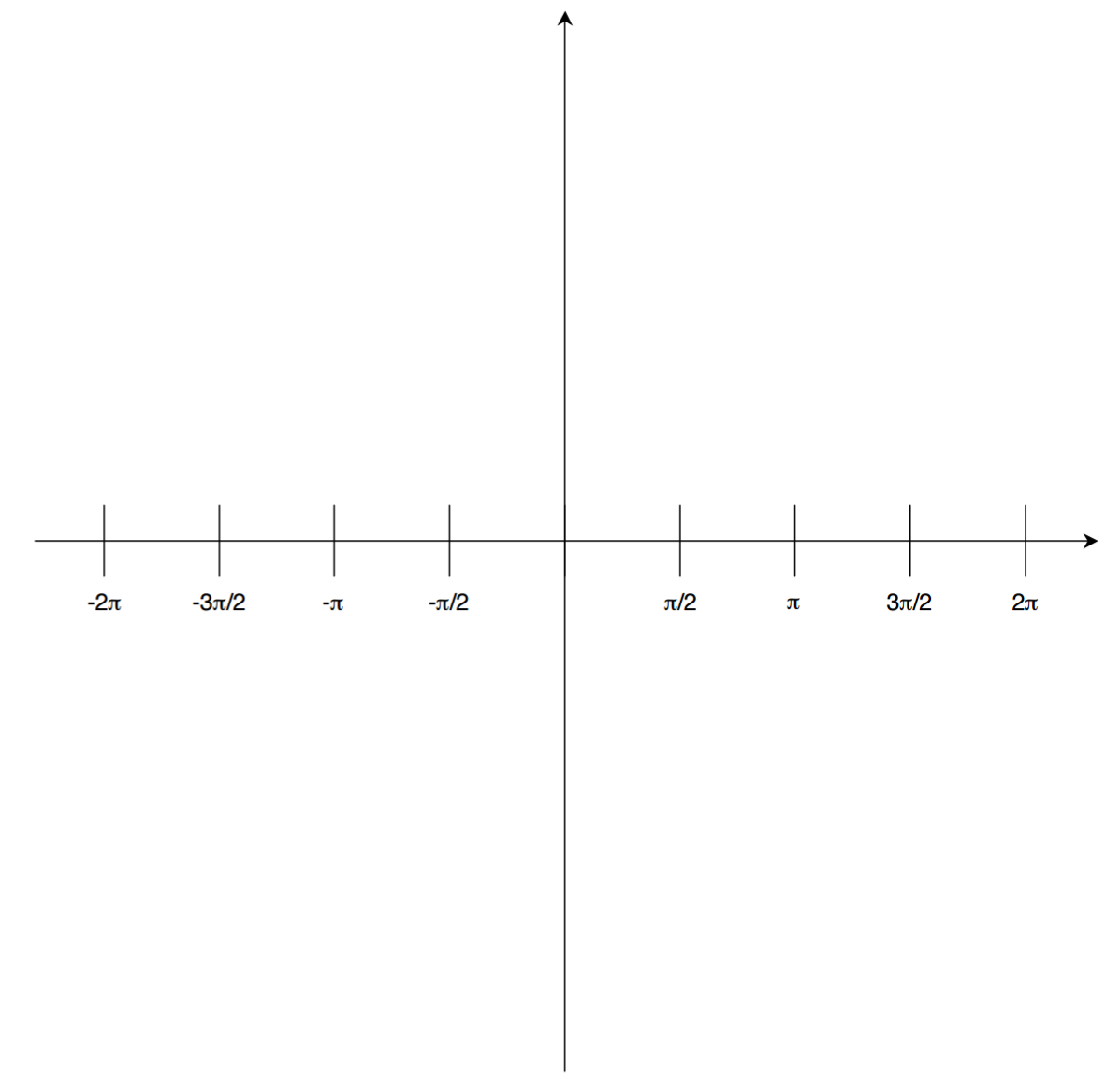
Sketch the graph of
\(f(x)= \sin(x)\) below. Is it one-to-one?
Figure 3.1.1.
Also recall that we can sometimes restrict the domain of a function so that, in its restricted interval, it is one-to-one. List at least two intervals where
\(f(x)= \sin(x)\) is one-to-one.
Definition 3.1.2 .
The
inverse sine function is defined as
\(\arcsin x=y\) (also written
\(\sin^{-1} x = y\) ) if
\(\sin y = x\) and
\(-\frac{\pi}{2} \leq y \leq \frac{\pi}{2}\text{.}\)
Problem 3.1.3 .
Is the function
\(f(x)= \cos(x)\) one-to-one? List at least two intervals where
\(f(x)= \cos(x)\) is one-to-one.
Figure 3.1.4.
Definition 3.1.5 .
The
inverse cosine function is defined as
\(\arccos x=y\) (also written
\(\cos^{-1} x = y\) ) if
\(\cos y = x\) and
\(0 \leq y \leq \pi\text{.}\)
Definition 3.1.6 .
The
inverse tangent function is defined as
\(\arctan x=y\) (also written
\(\tan^{-1} x = y\) ) if
\(\tan y = x\) and
\(-\frac{\pi}{2} < y < \frac{\pi}{2}\text{.}\)
Example 3.1.7 .
Consider the equation
\(\sin x = \frac{1}{2}\text{.}\) We now have two tools to solve this equation.
Use Desmos to graph
\(y=\sin x\) and
\(y=\frac{1}{2}\text{.}\) Use the graphs to find at least four solutions to
\(\sin x = \frac{1}{2}\text{.}\)
Sketch the graph below and label the solutions to
\(\sin x = \frac{1}{2}\text{.}\)
Figure 3.1.8.
Calculate
\(\arcsin (\frac{1}{2})\text{.}\)
How are your solutions to
Item 1 and
Item 2 the same and how are they different?
Problem 3.1.9 .
Solve each equation on the interval
\([0,2\pi)\text{.}\) Leave your answer in exact form.
\(\displaystyle \sin\theta=0\)
\(\displaystyle \cos\theta=\frac{1}{2}\)
\(\displaystyle \cos\theta=-\frac{\sqrt{3}}{2}\)
\(\displaystyle \tan\theta=\sqrt{3}\)
\(\displaystyle \tan\theta=-1\)
Problem 3.1.10 .
An angle
\(t\) is a positive angle in the second quadrant, and
\(\sin t = .3\text{.}\) Solve for
\(t\text{.}\)
Problem 3.1.11 .
An angle
\(\alpha\) is a positive angle in the fourth quadrant, and
\(\cos \alpha = .2\text{.}\) Solve for
\(\alpha\text{.}\)
Problem 3.1.12 .
An angle
\(w\) is a positive angle in the fourth quadrant, and
\(\tan w = -\frac{1}{3}\text{.}\) Solve for
\(w\text{.}\)
Problem 3.1.13 .
Let
\(f(z)=5 \cos (\frac{z}{7})\text{.}\)
Find a solution to
\(f(z)=-3\text{.}\)
Find
\(f^{-1}\text{,}\) and specify the domain and range of
\(f^{-1}\text{.}\)
Problem 3.1.14 .
Let
\(g(x)=4 \tan (2x)\text{.}\)
Find at least two solutions to
\(g(x)=4\text{.}\)
Find
\(g^{-1}\text{,}\) and specify the domain and range of
\(g^{-1}\text{.}\)