Skip to main content
Contents Dark Mode Prev Up Next \(
\newcommand{\lt}{<}
\newcommand{\gt}{>}
\newcommand{\amp}{&}
\definecolor{fillinmathshade}{gray}{0.9}
\newcommand{\fillinmath}[1]{\mathchoice{\colorbox{fillinmathshade}{$\displaystyle \phantom{\,#1\,}$}}{\colorbox{fillinmathshade}{$\textstyle \phantom{\,#1\,}$}}{\colorbox{fillinmathshade}{$\scriptstyle \phantom{\,#1\,}$}}{\colorbox{fillinmathshade}{$\scriptscriptstyle\phantom{\,#1\,}$}}}
\)
Subsection 3.2 Solving Trigonometric Equations Exercises
Let
\(\sin \theta = -.15\text{.}\)
Find
\(\theta\) if
\(\theta\) is a negative angle in the fourth quadrant.
Find
\(\theta\) if
\(\theta\) is a positive angle in the fourth quadrant.
Find
\(\theta\) if
\(\theta\) is a positive angle in the third quadrant.
Solve each equation on the interval
\([0, 2\pi)\text{.}\) Check your answers in Desmos.
\(\displaystyle 1+\cos\theta=\frac{1}{2}\)
\(\displaystyle 3\sec\theta=3\sqrt{2}\)
\(\displaystyle 1=-\sin(-\theta)\)
\(\displaystyle -2\sin(\theta+\frac{3\pi}{2})=\sqrt{3}\)
\(\displaystyle -6\cos^2\theta+3=-2\cos^2\theta\)
\(\displaystyle 0=-3\csc^2\theta+4\)
Let
\(g(x) = 3\sin x -2\text{.}\)
Graph the function on the domain
\(-2\pi \leq x \leq 2\pi\text{.}\) Be sure to label the midline, amplitude, and period.
Graph the function
\(s(x)=\sin x\) on the same graph as in
Item 3.a . Then explain how
\(s(x)\) is transformed to create the graph of
\(g(x)\text{.}\)
Again referring to the graph in
Item 3.a , write out the intervals on the domain
\(-2\pi \leq x \leq 2\pi\) on which
\(g(x)\) is decreasing.
List all solutions to
\(3\sin x -2 = 1\) on the interval
\(-2\pi \leq x \leq 2\pi\text{.}\) Give your answer in exact form.
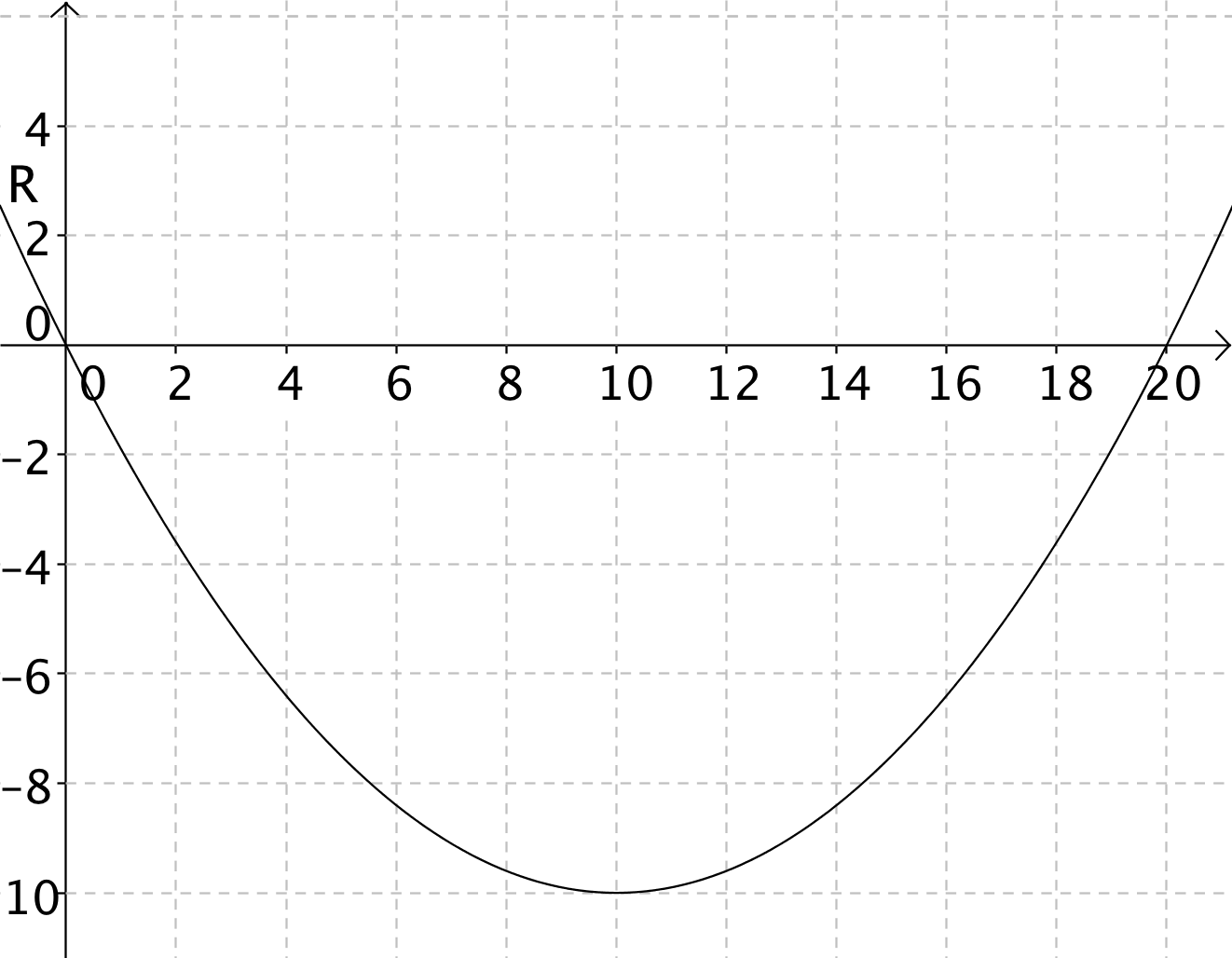
Refer to the graph of
\(R(x)\) in
Figure 3.2.6 .
Figure 3.2.6.
Solve the inequality
\(R(x) \geq 0\text{.}\)
Write a function equation for
\(R(x)\text{.}\)
What is the range of the function
\(R(x)\) on the domain
\(2 \leq x \leq 18\text{?}\)
What is the average rate of change of
\(R(x)\) on the domain
\(2 \leq x \leq 8\text{?}\)
Give an example of a domain on which the average rate of change of
\(R(x)\) is 0.
Write a function equation for a function that has a graph that is shifted 3 units left and 4 units down from the graph of
\(R(x)\text{.}\)
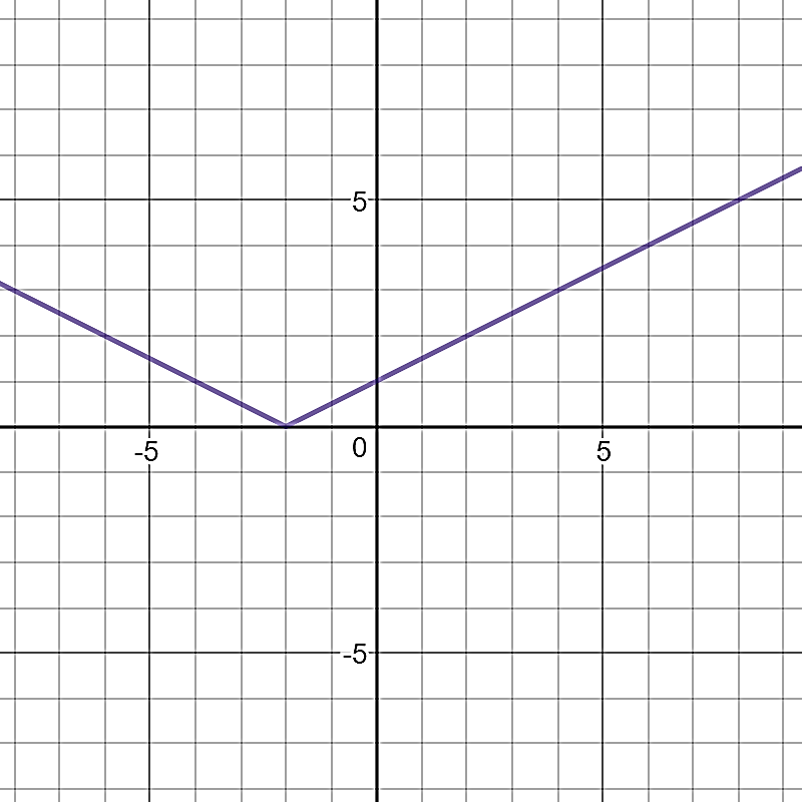
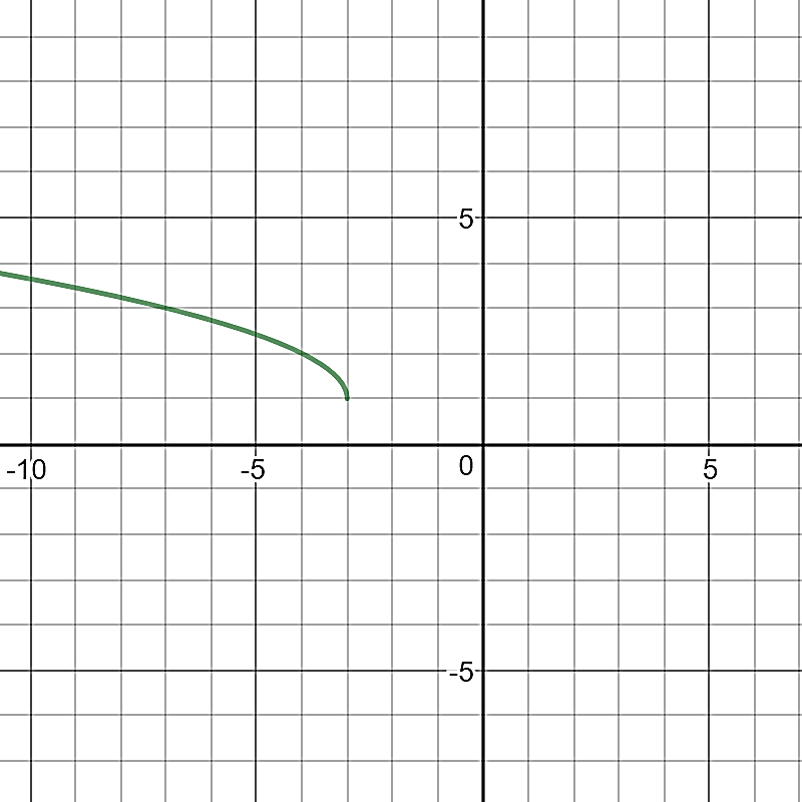
For each graph given, (a) identify the function family (linear, quadratic, exponential, linear absolute value, reciprocal, square root, cubic), and (b) identify how the basic function has been transformed to produce the graph given (c) write an equation of the graph.
Figure 3.2.7.
Simplify each expression. Write your answers without negative exponents.
\(\displaystyle (5x^3y^{-3}z)^{-2}\)
\(\displaystyle \sqrt[3]{8x^{-6}z^{3}}\)
\(\displaystyle \frac{x^2-3x+1}{\sqrt{x}}\)
Refer to the function
\(g(x)=\frac{3x+5}{x-2}\text{.}\)
What are the domain and range of
\(g(x)\text{?}\)
Graph
\(g(x)\) labeling all important features.
Find a function equation for the inverse function,
\(g^{-1}\text{.}\)
What are the domain and range of
\(g^{-1}(x)\text{?}\)