Trigonometric functions are used in many contexts. At the most basic level, trigonometric functions relate angle measurements to distances. We will see that the trigonometric functions are useful for modeling circular motion as well.
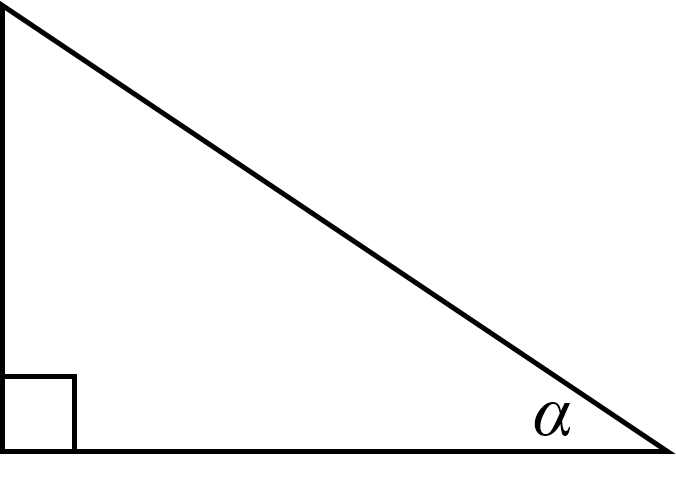
In a right triangle, for an angle \(\alpha\) (alpha), define \(\sin \alpha = \frac{opposite}{hypotenuse}\text{,}\)\(\cos \alpha=\frac{adjacent}{hypotenuse}\text{,}\) and \(\tan \alpha = \frac{opposite}{adjacent}\) (the acronym to remember these is SOHCAHTOA).
Suppose that \(\triangle DEF\) is a right triangle, with right angle at \(E\text{.}\) Let \(m \angle D = \beta\) (“beta"), and let \(DF=4\) and \(EF=2\text{.}\) Determine \(DE\text{,}\) and then use the side lengths to compute \(\sin (\beta)\text{,}\)\(\cos (\beta)\text{,}\) and \(\tan (\beta)\text{.}\)
From a boat, which is 150 meters out from the bottom of a cliff, the angle of elevation to the top of the cliff is 42\(^{\circ}\text{.}\) What is the height of the cliff?
A hot air balloon is tethered to the ground as shown. If the length of the rope is 100 feet, and the angle the rope makes with the ground is \(\frac{\pi}{3}\) radians, find the height of the hot air balloon.
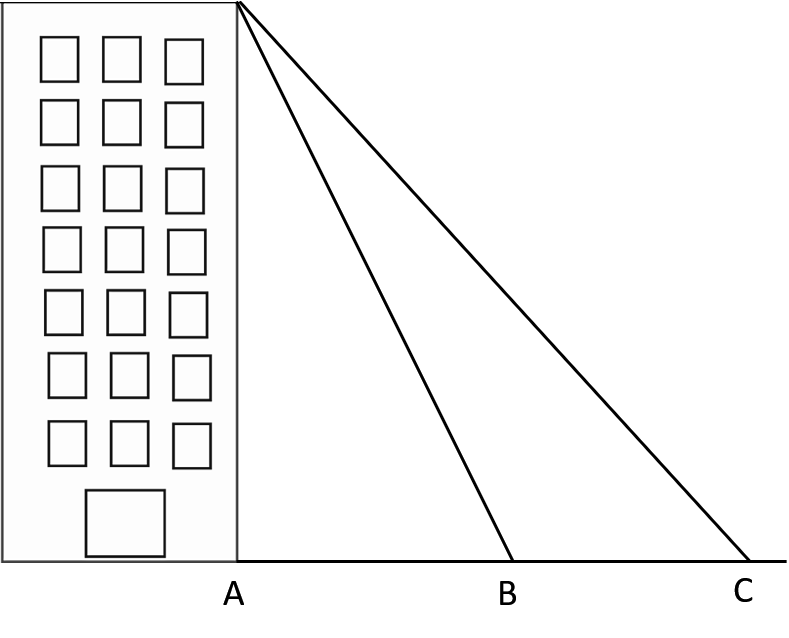
From point B you measure the angle of elevation from the ground to the top of a building that is 55 feet tall to be 65\(^{\circ}\text{.}\) You walk further away, and you measure that the angle of elevation at point C to be 40\(^{\circ}\text{.}\) How far did you walk between point B and point C?
Standing at the shore on a pier that is 6 m long and 2.5 m above the water, you observe that the angle of elevation to the top of a boat docked at the end of the pier is \(\frac{\pi}{10}\) radians. If your eye level is 1.5 m above the ground, how tall is the boat?
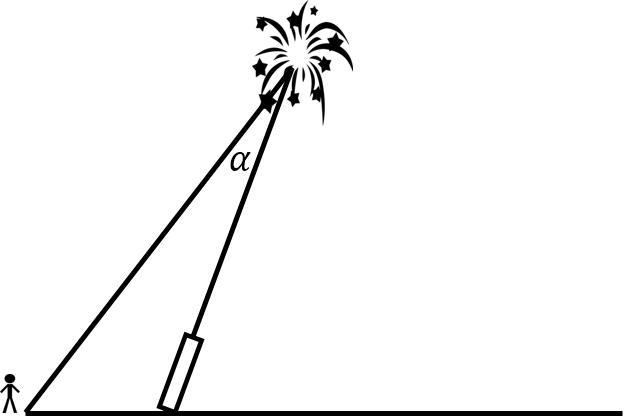
Fireworks are being shot out of a cannon at an angle of \(\frac{5 \pi}{12}\) radians with the ground. You are standing 200 m behind the cannon, and you observe that the angle of elevation from the ground where you are standing to where the fireworks are exploding is \(\frac{\pi}{4}\) radians.
A 10-foot ladder is going to be leaned against a wall. The ladder will be sturdy if the angle it makes with the wall is between \(\frac{\pi}{12}\) and \(\frac{\pi}{6}\text{.}\) How high up the wall can the ladder make contact with the wall?
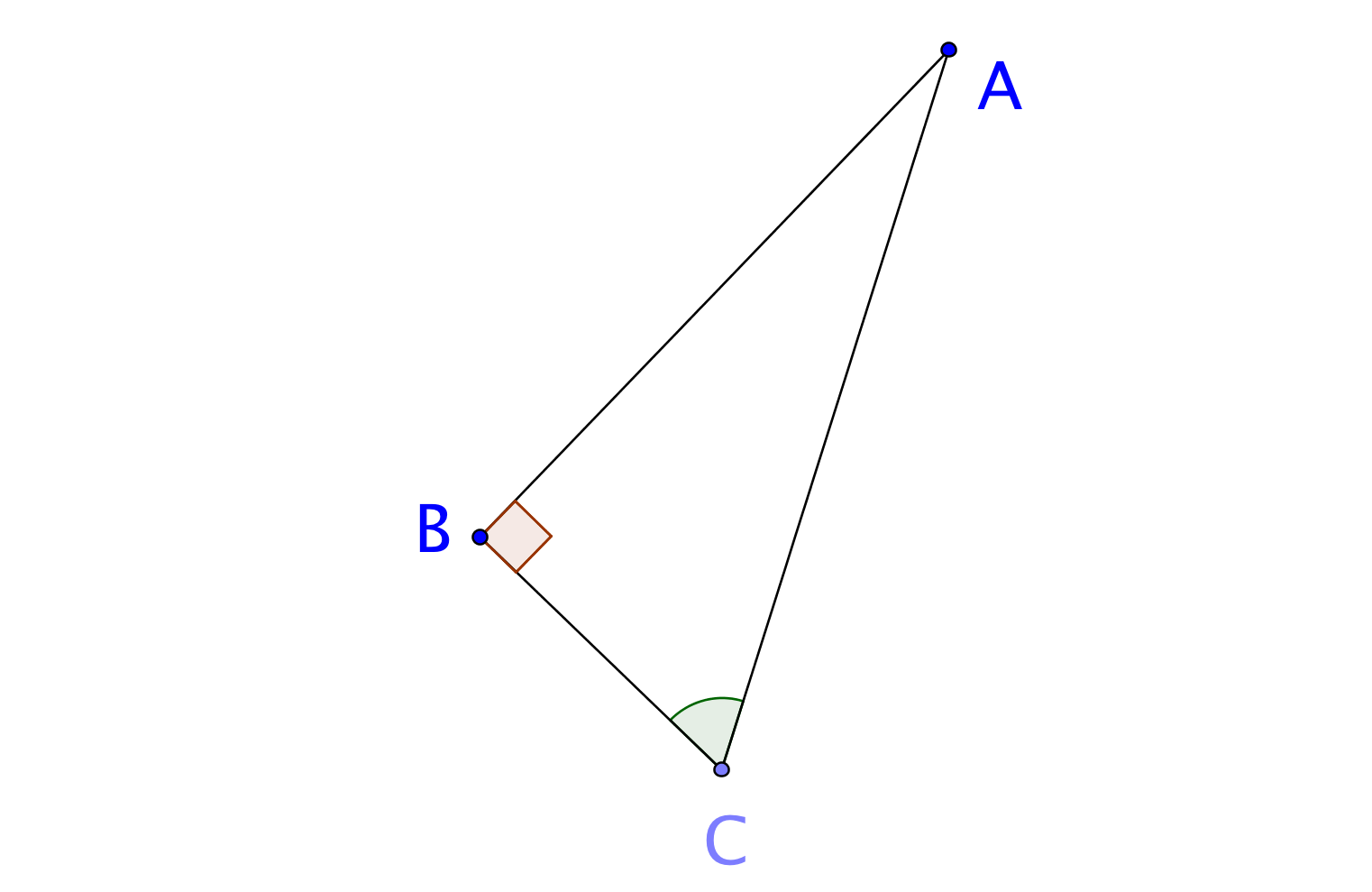
Let \(m\angle C = \phi\) (pronounced “fee"). Write \(\sin \phi\text{,}\)\(\cos \phi\text{,}\) and \(\tan \phi\) in terms of the side lengths \(AB\text{,}\)\(AC\text{,}\) and \(BC\text{.}\)
Let \(\theta = m \angle BAC\) (theta). Write \(\sin \theta\text{,}\)\(\cos \theta\text{,}\) and \(\tan \theta\) in terms of the side lengths \(AB\text{,}\)\(AC\text{,}\) and \(BC\text{.}\)
This demonstrates our first trigonometric identity. An identity is an equation that is true for all values of every variable in the equation for which the equation is defined. A trigonometric identity is an identity that involves trigonometric functions.