Subsection 0.2 Review of Function Concepts Exercises

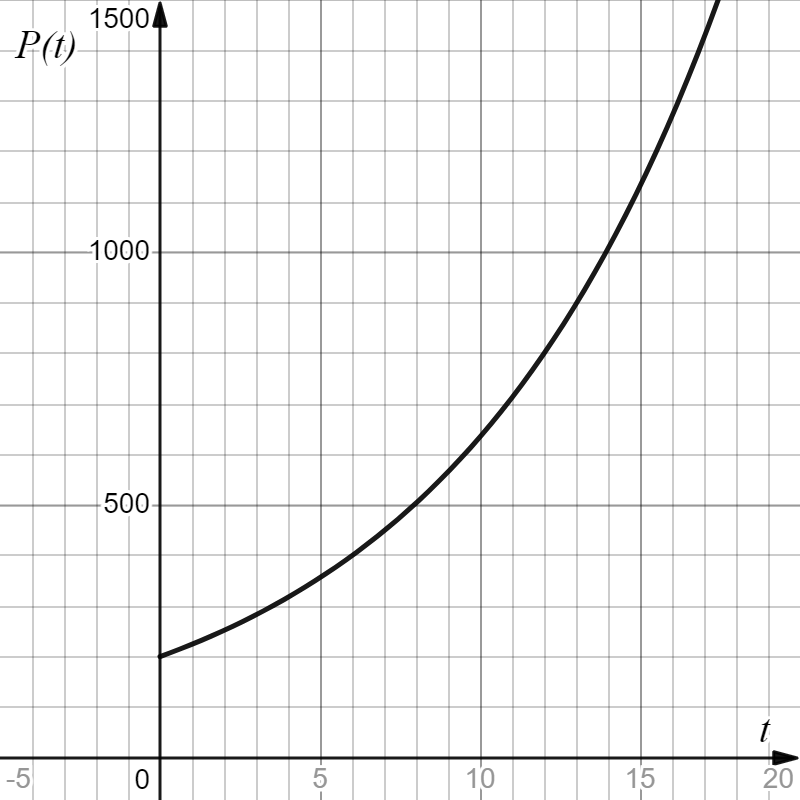
  1. The graph below shows \(P(t)\text{,}\) the number of bacteria in a petri dish \(t\) hours after an initial colony of bacteria was placed in the dish.
    The graph of \(P(t)\) is an upward-curving exponential-like function. It starts at \((0, 200)\) and rises increasingly steeply as \(t\) increases. By \(t = 8\text{,}\) the value is 500, and by \(t = 17\text{,}\) it is about 1400. The curve shows continuous growth with accelerating rate.
    Figure 0.2.7. Graph of \(P(t)\text{.}\)
    1. How many bacteria were initially placed in the petri dish?
    2. How many bacteria were in the petri dish after 6 hours?
    3. How long does it take for the number of bacteria in the dish to double?
    4. How long does it take for the number of bacteria in the dish to reach 800 bacteria?
    5. Use the initial amount of bacteria in the dish from part ItemΒ 1.a and the length of time it takes for the bacteria to double from part ItemΒ 1.c to write an equation for \(P(t)\text{.}\)
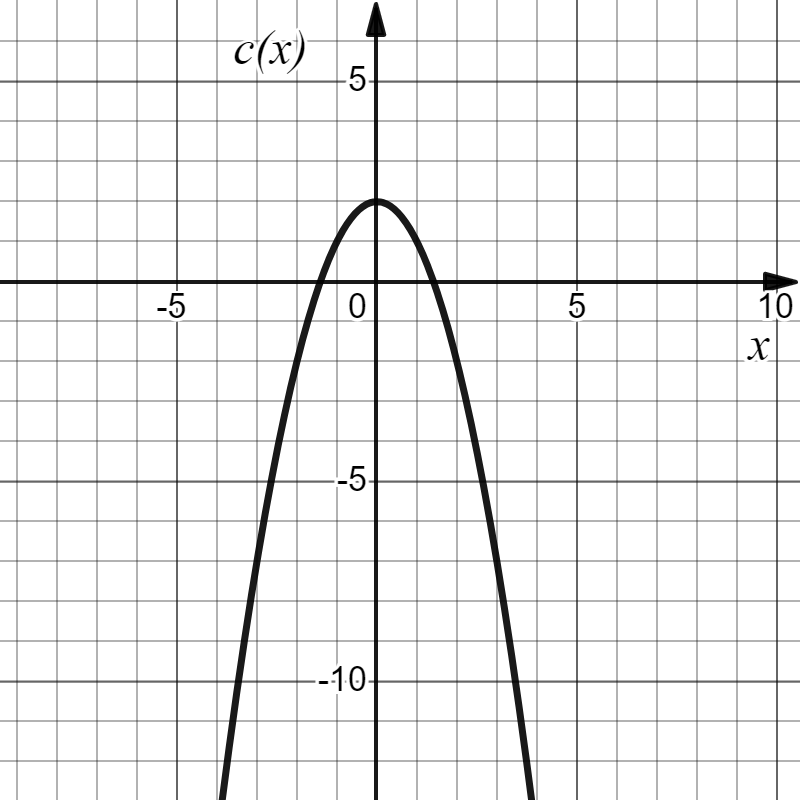
  2. Let \(a(x)=2x^3\text{,}\) \(b(x)=x-2\text{,}\) \(c(x)\) be defined in FigureΒ 0.2.8 and \(d(x)\) be defined in TableΒ 0.2.9 below.
    The graph of \(c(x)\) is a downward-opening parabola. The vertex is at \((0, 2)\text{,}\) which is the maximum point of the curve. The graph crosses the horizontal axis at two points, near \(x \approx -2\) and \(x \approx 2\text{,}\) and decreases on both sides of the vertex.
    Figure 0.2.8. Graph of \(c(x)\text{.}\)
    Table 0.2.9. Values of \(d(x)\)
    \(x\) \(d(x)\)
    \(-1\) \(0.25\)
    \(0\) \(0.5\)
    \(1\) \(1\)
    \(2\) \(2\)
    \(3\) \(4\)
    \(4\) \(8\)
    1. Evaluate \(c(2)\text{.}\)
    2. Evaluate \(d(3)\text{.}\)
    3. Solve \(d(x)=8\text{.}\)
    4. Solve \(b(x)=5\text{.}\)
    5. Solve \(b(x) \leq 12\text{.}\) Write your answer using interval notation.
    6. Solve \(c(x) = -7\text{.}\)
    7. Solve \(c(x) > -7\text{.}\) Write your answer using interval notation.
    8. Let \(y(x)=a(d(x))\text{.}\) Evaluate \(y(3)\text{.}\)
    9. Let \(v(x)=b(c(x))\text{.}\) Evaluate \(v(3)\text{.}\)
    10. Let \(t(x)=3c(x)-\frac{1}{2} d(x)\text{.}\) Evaluate \(t(3)\text{.}\)
    11. Find a function equation for \(z(x)=b(a(x))\text{.}\)
    12. Find a function equation for \(w(x)=a(x)-3b(x)\text{.}\)
    13. Write a problem that involves function composition using any of the four functions defined above. Make sure that you do your problem so you know for sure that it works.
    14. Write a problem that involves operations on functions (addition, subtraction, multiplication, division) using any of the for functions defined above. Make sure that you do your problem so you know for sure that it works.
    15. Write a function equation for the inverse of \(b\text{,}\) \(b^{-1}\text{.}\)
    16. Does \(c\) have an inverse function? What condition is required for a function to have an inverse?
    17. What are the domain and range of \(c\text{?}\)
    18. What kind of function would you use to model the relationship in the table for \(d\text{?}\) Explain.
  3. Let \(f(x)=x^2\text{,}\) \(g(x)=x+1\text{,}\) \(h(x)=2^x\text{.}\) Decide how each function below can be made with a composition or by adding, subtracting, multiplying or dividing functions \(f\text{,}\) \(g\) and \(h\text{.}\)
    1. \(\displaystyle j(x)=2^{x+1}\)
    2. \(\displaystyle k(x)=x^2+1\)
    3. \(\displaystyle m(x)=x^2+x+1\)
    4. \(\displaystyle n(x)=(2^x)^2\)
    5. \(\displaystyle p(x)=x^22^x\)
    6. \(\displaystyle q(x)=(x+1)^2\)
    7. \(\displaystyle r(x)=2^x+1\)