Skip to main content
Contents Dark Mode Prev Up Next \(
\newcommand{\lt}{<}
\newcommand{\gt}{>}
\newcommand{\amp}{&}
\definecolor{fillinmathshade}{gray}{0.9}
\newcommand{\fillinmath}[1]{\mathchoice{\colorbox{fillinmathshade}{$\displaystyle \phantom{\,#1\,}$}}{\colorbox{fillinmathshade}{$\textstyle \phantom{\,#1\,}$}}{\colorbox{fillinmathshade}{$\scriptstyle \phantom{\,#1\,}$}}{\colorbox{fillinmathshade}{$\scriptscriptstyle\phantom{\,#1\,}$}}}
\)
Subsection 1.3 Operations on Rational Expressions Exercises
Use long division to rewrite the expression
\(\frac{x^3+3x^2-4x-1}{x+2}\text{.}\)
Use long division to rewrite the expression
\(\frac{3x^3+11x^2-18x-56}{x+2}\text{.}\)
Perform the indicated operation on the given rational expressions.
\(\displaystyle \frac{x - 3}{x + 2} - \frac{5}{x^2 + 3x + 2}\)
\(\displaystyle \frac{2x - 3}{x^2 - 1} \cdot \frac{x + 1}{2x^2 - 5}\)
\(\displaystyle \frac{x}{x^2 + 4x - 5} + \frac{x^2 - 3}{x^2 + 7x + 10}\)
Refer to the function
\(g(x)=7x+2\text{.}\)
What are the domain and range of
\(g\text{?}\)
Let
\(h(x)=x^2+x+1\text{.}\) Find an algebraic expression for
\(g(h(x))\text{.}\)
Again using
\(h(x)=x^2+x+1\text{,}\) find an algebraic expression for
\(3g(x) - h(x)\text{.}\)
Find a function equation for the inverse function,
\(g^{-1}\text{.}\)
What are the domain and range of
\(g^{-1}\text{?}\)
Refer to
\(Q(x)=\sqrt[3]{x-3}\text{.}\)
What are the domain and range of
\(Q\text{?}\)
Let
\(U(x)=x^3\text{.}\) Find an algebraic expression for
\(U(Q(x))\text{.}\)
Let
\(V(x)=2U(x+3)\text{.}\) Describe how the graph of
\(V(x)\) differs from
\(U(x)\text{.}\) Verify your description by graphing both functions.
Find a function equation for the inverse function,
\(Q^{-1}\text{.}\)
What are the domain and range of
\(Q^{-1}\text{?}\)
Let
\(Y(x)=2x^2+8x-11\) and
\(H(x)=-x^2+3x+17\text{.}\)
Use algebra to find exact solutions to
\(Y(x)=H(x)\text{.}\) Verify your solutions using Desmos.
Solve
\(Y(x) \leq H(x)\text{.}\)
Atmospheric pressure (the force of air around you) decreases at higher altitudes. For every 1000 m gain in altitude, the air pressure decreases about 12%. The air pressure at sea level (altitude 0 meters) is 101.325 kPa (kPa are kiloPascals, metric units for pressure).
Write a function equation expressing the pressure,
\(P\text{,}\) in terms of the altitude
\(a\text{,}\) in meters.
What is the air pressure at the top of the Empire State Building (381 m)?
What is the air pressure at the top of Mount Everest (8848 m)?
At what altitude is air pressure half of what it is at sea level?
Write an equation that gives the altitude as a function of the air pressure. State the units of the domain and the range of this new function.
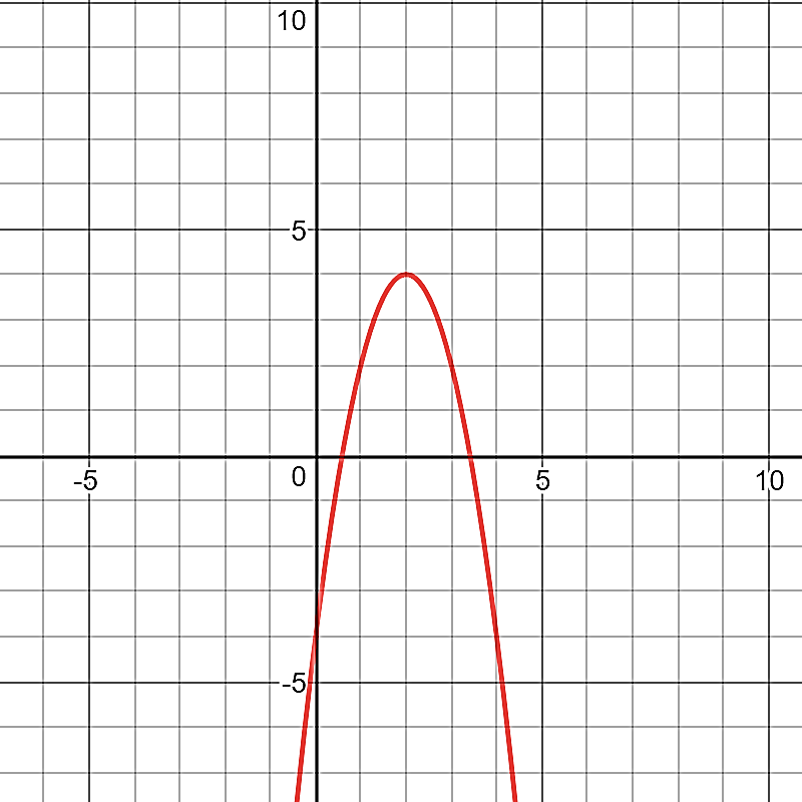
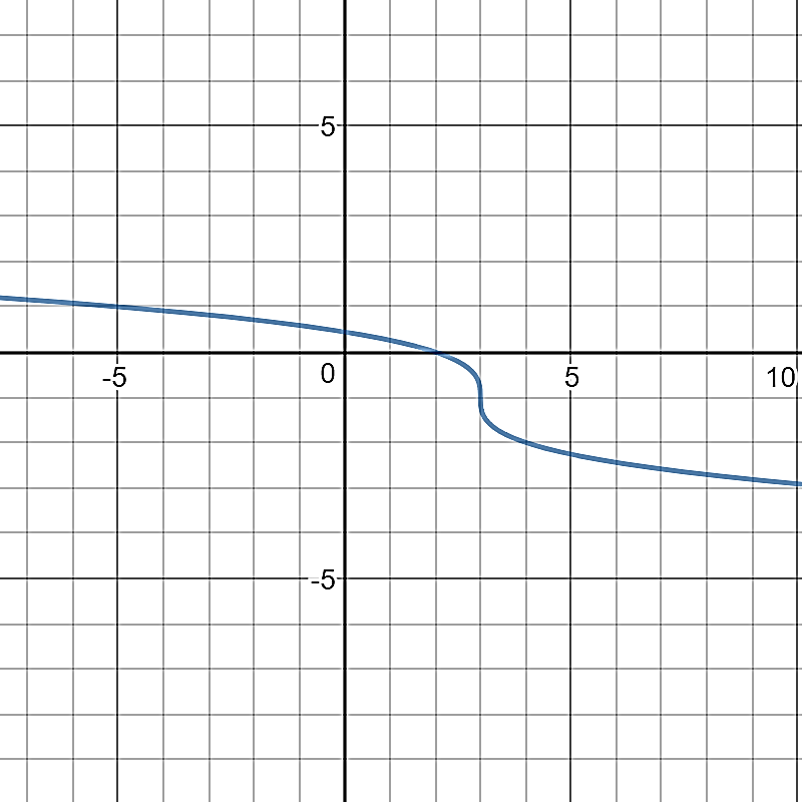
For each graph given, (a) identify the function family (linear, quadratic, exponential, linear absolute value, reciprocal, square root, cubic), and (b) identify how the basic function has been transformed to produce the graph given (c) write an equation of the graph.
Figure 1.3.11. Graph of a downward-opening function.
Figure 1.3.12. Graph of a decreasing function