Section 4.1 Modeling with Trigonometric Functions

Goals:
  • T: Be able to model a situation involving motion on a circle with appropriate trigonometric parametric equation(s) and interpret the solution.
Early in the semester, we saw that parametric equations can be used to describe the motion of an object in the plane. More recently, we have seen that the sine and cosine functions can be used to describe the coordinates of a point on the unit circle. In this section, we bring these two ideas together to develop parametric equations that describe the position of an object as it moves in a circle.

Example 4.1.1.

A Ferris wheel with a radius of 5 meters is mounted so that the center is 6 meters above the ground. At time \(t=0\text{,}\) a rider is in the 3 o’clock position on the wheel. The wheel makes one complete counterclockwise turn in 30 seconds.
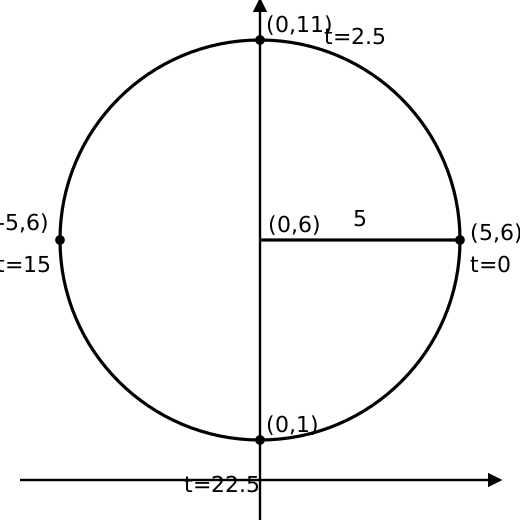
  1. Draw a diagram showing the Ferris wheel, with the origin at ground level under the center of the wheel.
  2. Write parametric equations to describe the position of the rider at time \(t\text{.}\)
  3. How far does the rider travel in the first 5 seconds of the ride?
  4. What are the coordinates of the rider at \(t=70\) seconds?
  5. Find two times when the rider is 10 meters above ground level.
Solution.
The solution to is shown below.
  1. A coordinate plane showing a circle of radius 5 centered at (0,6). The rightmost point (5,6) is labeled t=0, the top point (0,11) is labeled t=2.5, the left point (βˆ’5,6) is labeled t=15, and the bottom point (0,1) is labeled t=22.5. A radius from (0,6) to (5,6) is drawn and labeled 5.
    Figure 4.1.2.
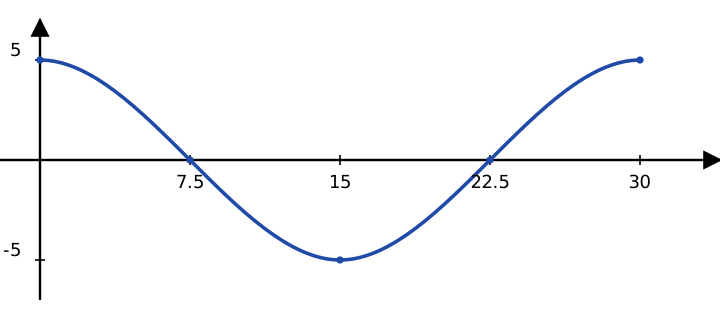
  2. First write an equation for \(x(t)\text{.}\) Start by making a table of the \(x\)-values at each labeled time. Then graph the values in the table.
    \(t\) \(x(t)\)
    \(0\) \(5\)
    \(7.5\) \(0\)
    \(15\) \(-5\)
    \(22.5\) \(0\)
    \(30\) \(5\)
    (a)
    A graph of x as a function of t showing a smooth periodic curve. The graph passes through the points (0,5), (7.5,0), (15,βˆ’5), (22.5,0), and (30,5), forming one full cycle with a maximum at t=0 and t=30 and a minimum at t=15.
    Figure 4.1.3.
    Using the graph, we can see that the amplitude is 5 and the midline is 0. The period is 30, so \(b=\frac{2 \pi}{30} = \frac{\pi}{15}\text{.}\) Since the cosine function has its maximum on the y-axis, we won’t need a horizontal shift if we use cosine. So our equation is
    \begin{equation*} x(t)=5\cos\!\left(\frac{\pi}{15}t\right) \end{equation*}
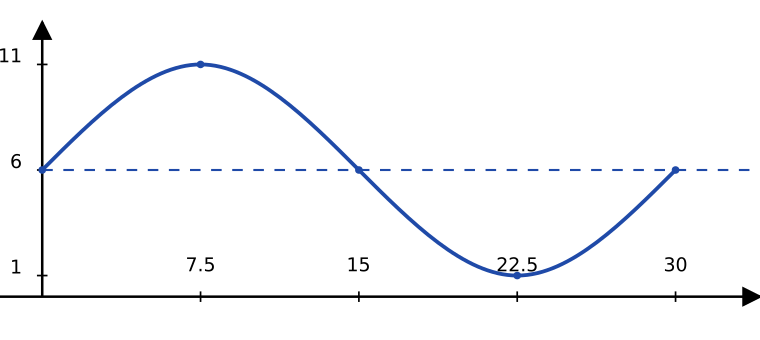
    Similarly, we can find the equation of \(y(t)\text{.}\)
    \(t\) \(y(t)\)
    \(0\) \(6\)
    \(7.5\) \(11\)
    \(15\) \(6\)
    \(22.5\) \(1\)
    \(30\) \(6\)
    (a)
    A graph of y as a function of t showing a smooth periodic curve with midline y = 6. The graph passes through the points (0,6), (7.5,11), (15,6), (22.5,1), and (30,6), completing one full cycle with a maximum at t = 7.5 and a minimum at t = 22.5.
    Figure 4.1.4.
    From the graph, we can see that the amplitude is 5, the midline is at \(y=6\) the period is 30, so \(b=\frac{2 \pi}{30} = \frac{\pi}{15}\text{.}\) The sine function has its midline on the \(y\)-axis, so we won’t need a horizontal shift if we use sine. So our equation is
    \begin{equation*} y(t)=5\sin\!\left(\frac{\pi}{15}t\right)+6 \end{equation*}
  3. In 5 seconds, the rider travels \(\frac{5}{30}=\frac{1}{6}\) of the circle. The angle subtended by this motion is \(\frac{1}{6}\) of \(2\pi\) radians, which is \(\frac{\pi}{3}\) radians. Using the arc length formula, the distance traveled by the rider is
    \begin{equation*} l=5\cdot\frac{\pi}{3}=\frac{5\pi}{3}\approx 5.24 \end{equation*}
    meters.
  4. \(\displaystyle \bigl(5\cos(\tfrac{\pi}{15}\cdot70),\,5\sin(\tfrac{\pi}{15}\cdot70)+6\bigr)=(-2.5,\,10.33)\)
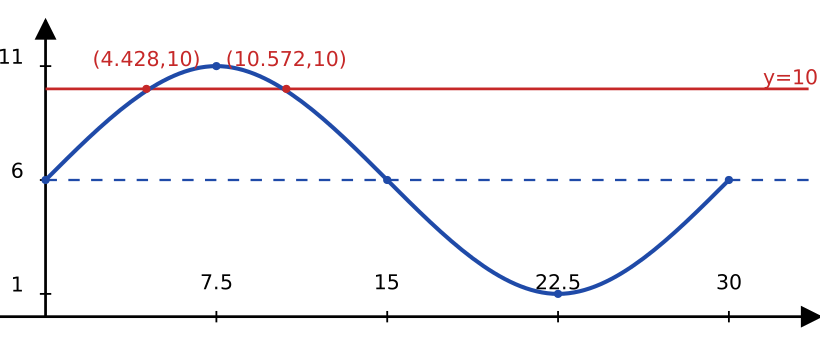
  5. Graph \(y(t)\) and \(y=10\text{.}\) The rider will be at a height of 10 meters at 4.428 seconds and 10.572 seconds after the ride began.
    A graph of y as a function of t showing a smooth periodic curve with midline y = 6. A horizontal line at y = 10 intersects the curve at approximately (4.428, 10) and (10.572, 10). The graph also passes through the points (0,6), (7.5,11), (15,6), (22.5,1), and (30,6). Both axes are shown with labeled tick marks.
    Figure 4.1.5.

Problem 4.1.6.

A carousel (merry-go-round) is on a pier that juts out eastward from a straight shoreline that runs north-south. The carousel has a diameter of 30 feet and takes 18 seconds to complete one counterclockwise revolution. The center of the carousel is 60 feet from the shoreline. Eden is riding one of the carousel horses, and starts at the point farthest from the shoreline. Let \(t=0\) denote this starting point.
  1. Draw a diagram with the point where the pier meets the shore as the origin, and the positive \(x\)-axis stretching along the pier through the center of the carousel.
  2. Graph the distance from Eden to the shoreline as a function of time for the interval from \(t=0\) to \(t=36\) seconds.
  3. Find a function of the form \(f(t)=A\cos(B(t-h))+k\) that represents the distance in feet from Eden to the shoreline as a function of time.
  4. Write parametric equations \((f(t),y(t))\) describing Eden’s location at time \(t\text{.}\)

Problem 4.1.7.

A circle has its center at \(C= (-3, 5)\text{,}\) and just touches the \(x\)-axis. An object is moving counterclockwise around the circle. At time \(t=0\text{,}\) the object is at the point \((-3,0)\text{,}\) and it takes \(1.5\) seconds to complete a revolution.
  1. Draw a diagram of the circle in the \(xy\)-plane.
  2. Write an equation for the circle.
  3. Find a function of the form \(f(t)=A\cos(B(t-h))+k\) that represents the \(x\)-coordinate of the point as a function of time.
  4. Find a function of the form \(g(t)=A\sin(B(t-h))+k\) that represents the \(y\)-coordinate of the point as a function of time.
  5. Find the coordinates of the object at time \(t=4\) seconds.
  6. Find all the times \(t\text{,}\) \(0 \leq t \leq 1.5\text{,}\) such that the \(y\)-coordinate of the point is \(2.5\text{.}\)
  7. Find all the times \(t\text{,}\) \(0 \leq t \leq 1.5\text{,}\) such that the \(x\)-coordinate of the point is \(-4\text{.}\)

Problem 4.1.8.

A boat is moored in a harbor, and moves up and down sinusoidally as the tide comes in and out. At low tide, the boat is 3 feet above the bottom of the ocean, and at high tide, the boat is 25 feet above the bottom of the ocean.
  1. If low tide occurs at 3 am and high tide occurs 9 am, write an equation that models the height of the boat above the ocean floor at \(t\) hours after 12 am.
  2. What will the height of the boat above the ocean floor be at 8 am?
  3. What is the first time after 12 am the height of the boat be 18 feet above the ocean floor?

Problem 4.1.9.

An automatic thermostat in a room is set so that the air conditioning will come on when the temperature reaches 75\(^{\circ}\) and turn off when it reaches 68\(^{\circ}\text{.}\) The time between when the air conditioner turns on and turns off is 15 minutes.
  1. If the temperature is 68\(^{\circ}\) at 12 pm, write a sinusoidal function that represents the temperature \(D\) (in degrees) as a function of the number of minutes since 12 pm.
  2. What will the temperature be in the room at 5 pm?
  3. What is the first time will the temperature in the room will be 73\(^{\circ}\text{?}\)