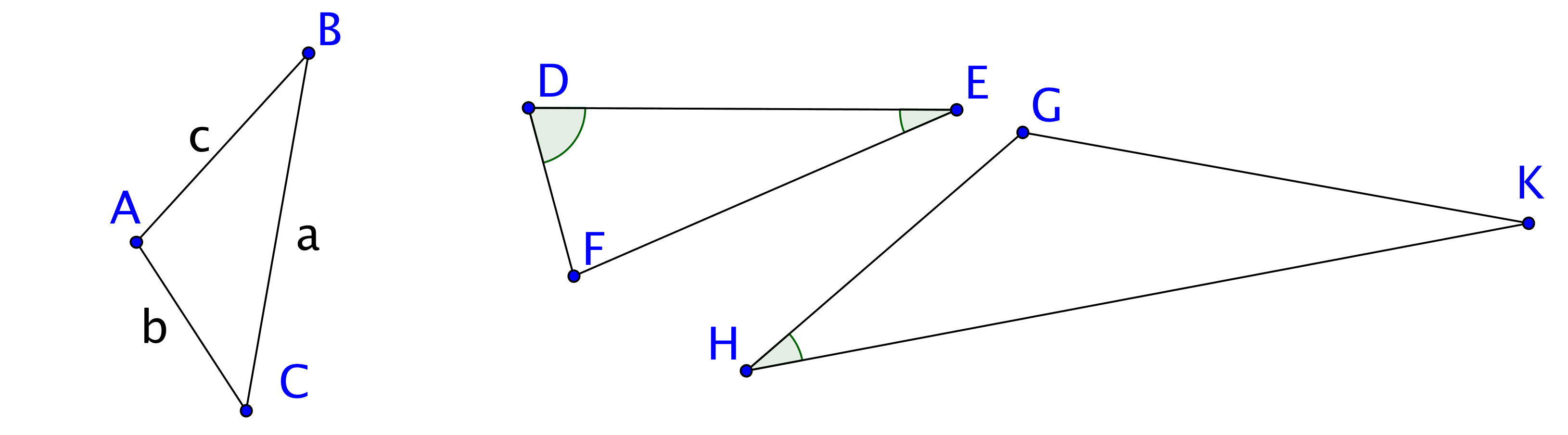
The Law of Sines and the Law of Cosines are formulas that are used to solve for unknown values in a triangle. While the SOHCAHTOA definitions apply only in right triangles, the law of sines and law of cosines apply in all triangles. Whether you need one or the other (or both) depends on what you know and what you need to know.
\begin{equation*}
c^2=a^2+b^2-2ab\cos C.
\end{equation*}
Note that while the Law of Cosines looks a little like the Pythagorean Theorem, and is in fact related to it, when using the law, it does not matter which angle acts as \(C\text{.}\)
Suppose that in \(\triangle DEF\text{,}\) we know that \(DF=1.84\) cm, \(m \angle DEF=.415\) radians, and \(m \angle FDE =1.303\) radians. Find the lengths of the other two sides of the triangle.
Two wires are going in opposite directions from the top of a post to the ground. The angle between the two wires is \(85^{\circ}\) degrees . The ends of the wires are 15 feet apart on the ground. One of the angles forms an angle of \(35^{\circ}\) with the ground. Find the lengths of the wires.
Two friends start at the same point and begin walking away from each other. Each person is walking in a straight line, and the angle made by their two directions is \(\frac{5}{9} \pi\text{.}\) After an hour, one person has walked 5 miles and the other has walked 6.5 miles. How far apart are they?
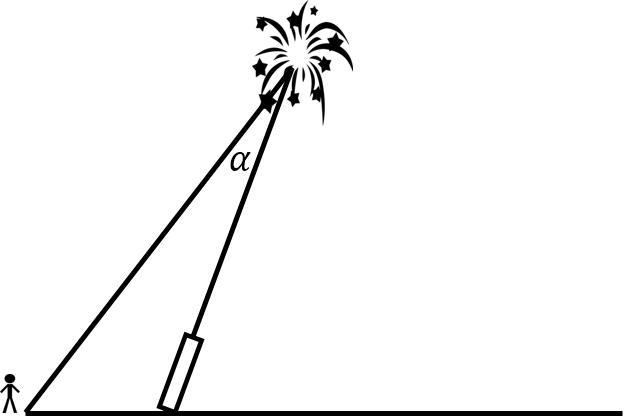
Recall Figure 2.2.12 from a previous section. Fireworks are being shot out of a cannon at an angle of \(\frac{5 \pi}{12}\) radians with the ground. You are standing 200 m behind the cannon, and you observe that the angle of elevation from the ground where you are standing to where the fireworks are exploding is \(\frac{\pi}{4}\) radians.