Skip to main content
Contents Dark Mode Prev Up Next \(
\newcommand{\lt}{<}
\newcommand{\gt}{>}
\newcommand{\amp}{&}
\definecolor{fillinmathshade}{gray}{0.9}
\newcommand{\fillinmath}[1]{\mathchoice{\colorbox{fillinmathshade}{$\displaystyle \phantom{\,#1\,}$}}{\colorbox{fillinmathshade}{$\textstyle \phantom{\,#1\,}$}}{\colorbox{fillinmathshade}{$\scriptstyle \phantom{\,#1\,}$}}{\colorbox{fillinmathshade}{$\scriptscriptstyle\phantom{\,#1\,}$}}}
\)
Subsection 0.1 Review of Linear and Quadratic Functions Exercises
Write a linear function equation for each function given below.
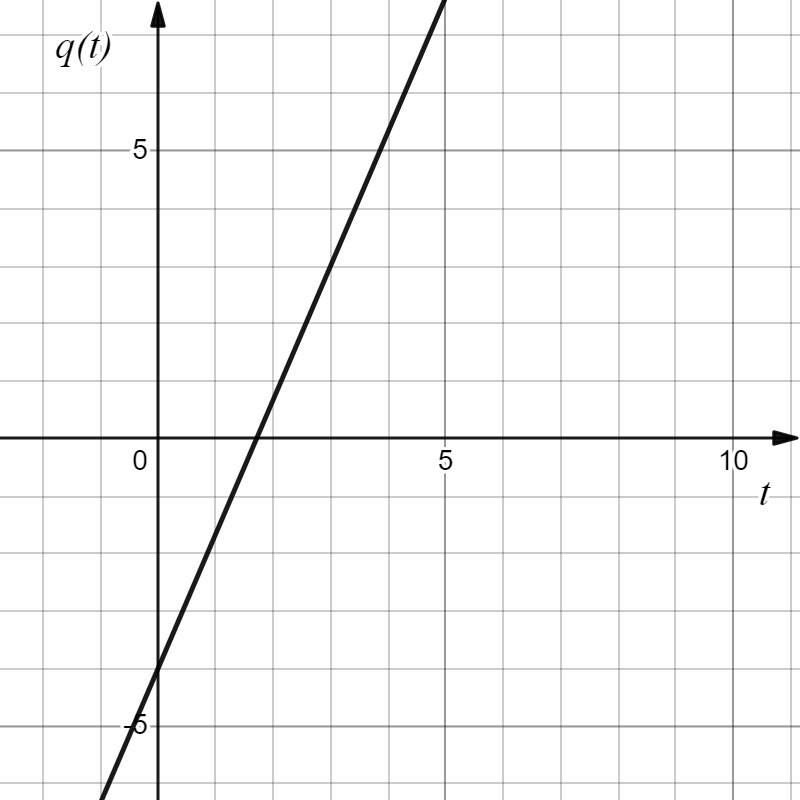
The function
\(q\) shown in the graph below.
Figure 0.1.10. Graph of \(q(t)\text{.}\)
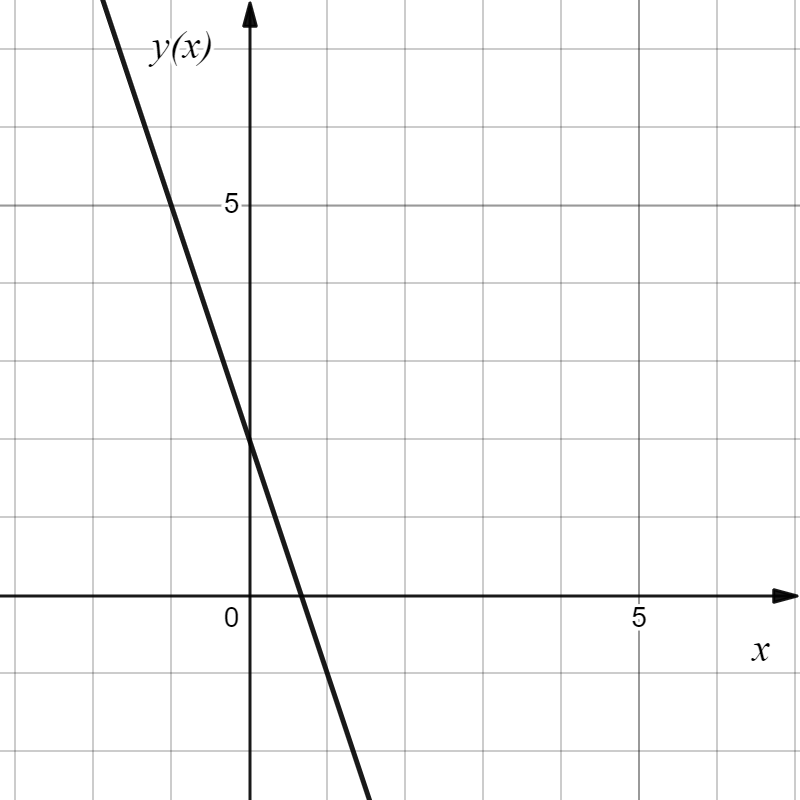
The function
\(y\) shown in the graph below.
Figure 0.1.11. Graph of \(y(x)\text{.}\)
The function
\(b\) shown in the table below.
Table 0.1.12.
\(b(x)\) \(-5\) \(-1\) \(3\) \(7\) \(11\)
The function
\(h\) shown in the table below.
Table 0.1.13.
\(h(t)\) \(-74\) \(-62\) \(-50\) \(-38\) \(-26\)
Giovanni is saving money to buy a PS5. He started saving with $145 (that he got for Christmas), and he is able to save $35 per week from his paycheck to put toward the PS5.
Write an equation for
\(s(t)\text{,}\) the amount of savings Giovanni has
\(t\) weeks after he started saving.
How much will Giovanni have saved after 6 weeks?
How long will it take Giovanni to save enough money for a PS5 ($500)?
A car rental company charges $40 for the first day of car rental, and $30 for each day after that.
Write an equation for
\(c(d)\text{,}\) the total cost to rent a car for
\(d\) days.
How much will it cost to rent a car for 15 days?
For how many days did you rent a car if you paid $280?
Solve each equation or inequality below.
\(\displaystyle 1-n+6n=6\)
\(\displaystyle 3(1+5x)=78\)
\(\displaystyle 6(-x-5)-2x=-78\)
\(\displaystyle -2(-7n-11)=8(n-4)\)
\(\displaystyle 3+10x > 33\)
\(\displaystyle -7 \geq \frac{-10+a}{3}\)
\(\displaystyle -2(5+5m) > -90\)
\(\displaystyle 3+4r \leq 7(7r-6)\)
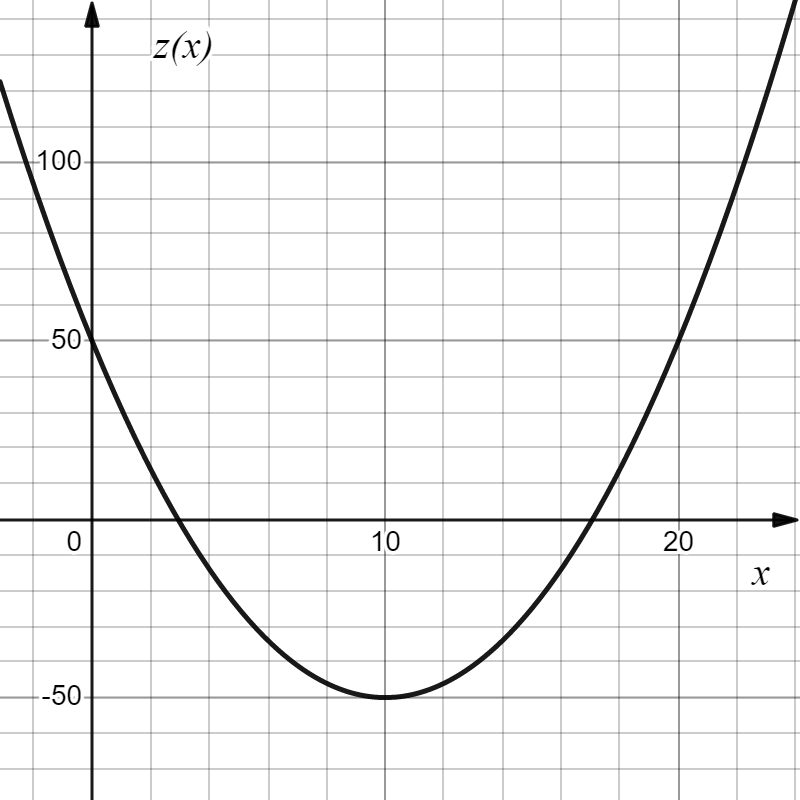
Use the graph of
\(z(x)\) below to answer the following questions.
Figure 0.1.14. Graph of \(z(x)\text{.}\)
What is the vertex of the graph of
\(z\text{?}\)
Write an equation for
\(z\text{.}\)
Solve
\(z(x)=50\text{.}\)
Solve
\(z(x) \geq 50\text{.}\)
Find the
\(x-\) intercepts of
\(z\text{.}\)
Find the vertical intercept of
\(z\text{.}\)
What are the domain and range of
\(z\text{?}\)
Solve each equation below.
\(\displaystyle n^2+3n-28=0\)
\(\displaystyle 3x^2-x-14=0\)
\(\displaystyle r^2-20=-r\)
\(\displaystyle 8x^2+3=64x+3\)
\(\displaystyle 3b^2+1=4\)
\(\displaystyle 12x^2-12=11x\)
\(\displaystyle 6x^2-5=-7x\)
\(\displaystyle n^3+n^2-2n=0\)
\(\displaystyle a^4-6a^2-16=0\)