Skip to main content
Contents Dark Mode Prev Up Next \(
\newcommand{\lt}{<}
\newcommand{\gt}{>}
\newcommand{\amp}{&}
\definecolor{fillinmathshade}{gray}{0.9}
\newcommand{\fillinmath}[1]{\mathchoice{\colorbox{fillinmathshade}{$\displaystyle \phantom{\,#1\,}$}}{\colorbox{fillinmathshade}{$\textstyle \phantom{\,#1\,}$}}{\colorbox{fillinmathshade}{$\scriptstyle \phantom{\,#1\,}$}}{\colorbox{fillinmathshade}{$\scriptscriptstyle\phantom{\,#1\,}$}}}
\)
Subsection 5.1 Trigonometric Identities Exercises
Prove each trigonometric identity.
\(\displaystyle \sec{x} - \cos{x} = \tan{x} \sin{x}\)
\(\displaystyle (\csc^2 x - 1)(\tan^2 x) =1\)
\(\displaystyle \csc^2 x + \sec^2 x - \cot^2 x = 2 + \tan^2 x\)
Solve each equation on the interval
\([0, 2\pi)\text{.}\)
\(\displaystyle \sec \theta -2 = 0\)
\(\displaystyle \sin 2x = -1\)
\(\displaystyle \sin^2 x - \sin x = 2\)
\(\displaystyle \tan^2 \theta - 1 =0\)
\(\displaystyle \sin x = \sin x \tan x\)
\(\displaystyle 4\cos^2 x +5 \cos x + 1 = 0\)
\(\displaystyle 8\sin^2 x - 3 \sin x + 1 = 0\)
A triangle
\(ABC\) has vertices
\(A=(1,0)\text{,}\) \(B=(4,4)\text{,}\) and
\(C=(-4,12)\text{.}\)
What are the lengths of the edges of the triangle?
What are the measures of the angles of the triangle (in radians)?
What is the area of the triangle?
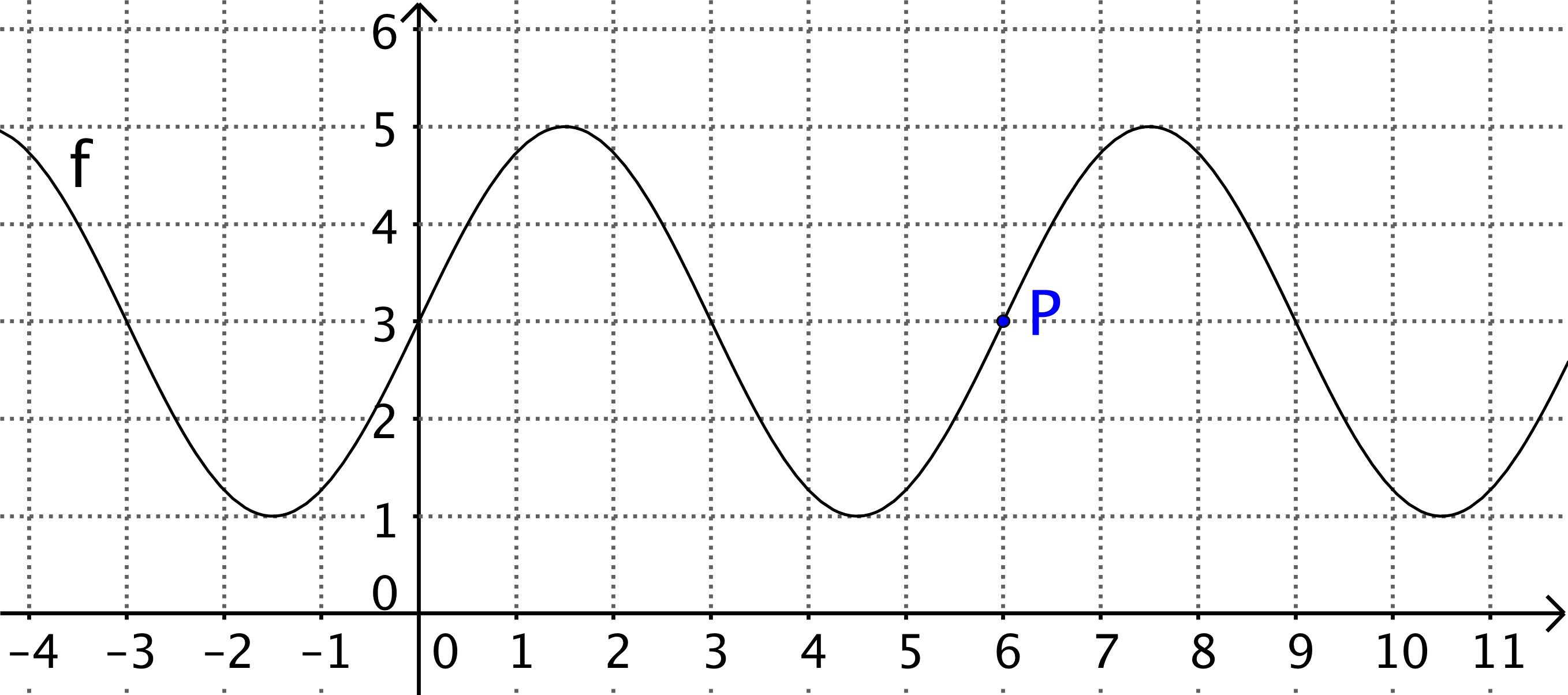
Refer to
\(f\) as shown in
Figure 5.1.5 . Note that
\(P=(6,3)\text{.}\)
Figure 5.1.5.
Write a function equation for
\(f\) of the form
\(a\sin (b(x-h))+k\text{.}\)
Use your function equation to give all solutions to
\(f(x)=5\) on the domain
\(0 \leq x \leq 10\text{.}\) Verify your answer using the graph of
\(f\text{.}\)
Evaluate
\(f(4)\text{.}\) Verify your answer using the graph of
\(f\text{.}\)
Write a function equation for
\(f\) of the form
\(A\cos (B(x-H))+K\text{.}\)
Considering only the domain
\(0 \leq x \leq 10\text{,}\) on which intervals is
\(f\) increasing?
A carousel is in a park. The center of the carousel is 60 feet due south of the entrance to the park. The carousel has a diameter of 28 feet and takes 14 seconds to complete one counterclockwise revolution. Simon is riding one of the carousel horses, and starts at the point farthest from the park entrance. Let
\(t=0\) denote this starting point.
Draw a diagram with the entrance to the park as the origin, and the
\(y\) -axis stretching through the center of the carousel.
Graph Simon’s
\(y\) -coordinate as a function of time for the interval from
\(t=0\) to
\(t=28\) seconds.
Find a function of the form
\(f(t)=A\sin(B(t-h))+k\) that represents the
\(y\) -coordinate in feet for Simon as a function of time.
Write parametric equations
\((x(t), f(t))\) describing Simon’s location at time
\(t\text{.}\)
What is Simon’s location at
\(t=10\) seconds?
What distance around the circle does Simon travel in 10 seconds on the ride?
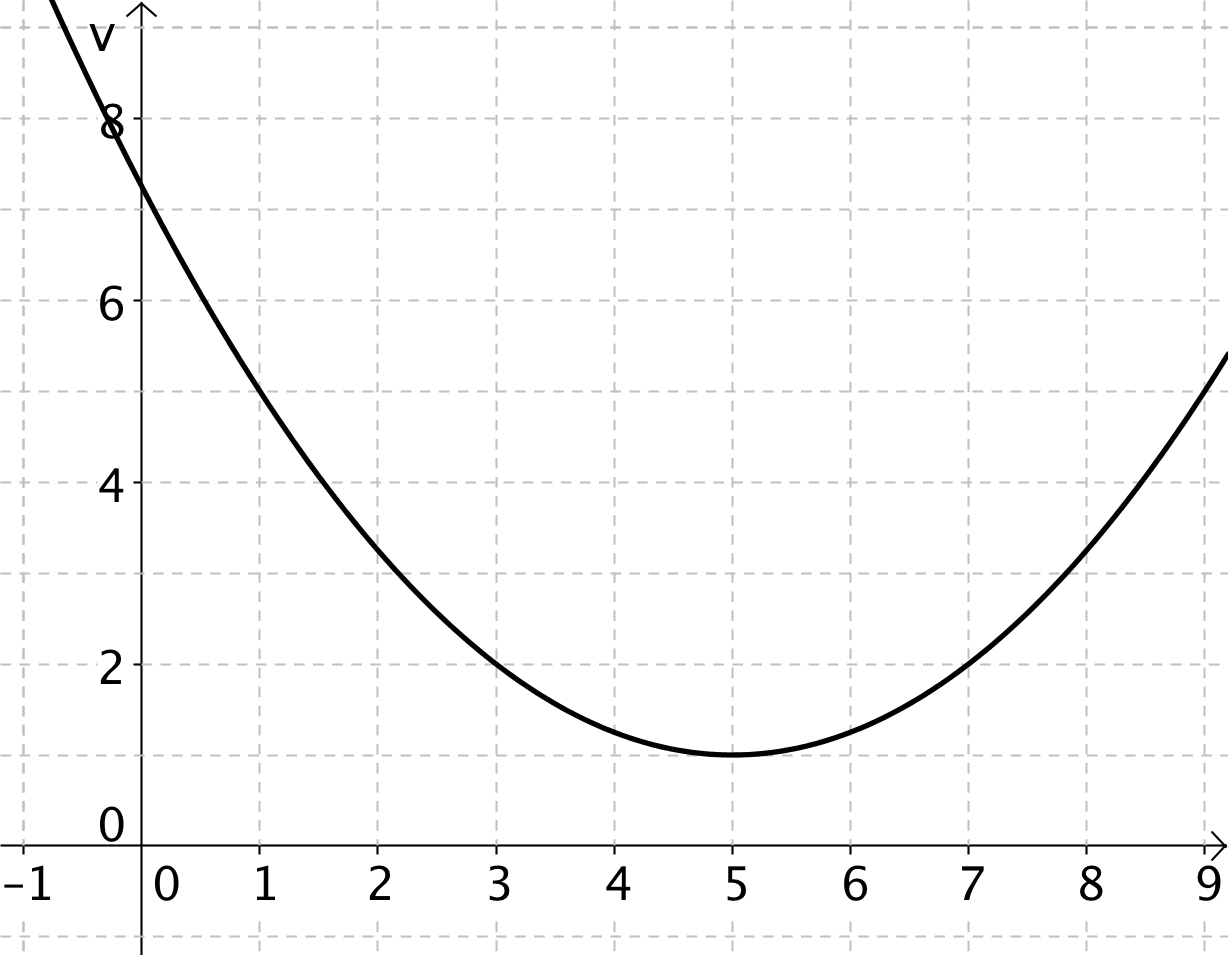
Refer to the graph of
\(v(x)\) in
Figure 5.1.6 .
Figure 5.1.6.
On which interval(s) is
\(v(x)\) increasing?
What is the average rate of change of
\(v(x)\) on the interval
\(2 \leq x \leq 5\text{?}\)
Solve the inequality
\(v(x) \geq 0\text{.}\)
Write a function equation for
\(v(x)\text{.}\)
\(\displaystyle \log (x+6) + \log x = 2\)
\(\displaystyle \ln 6 - \ln (4x+1) = 1\)
Let
\(f(x)=2|-x+1|-3\text{.}\)
Describe the transformations that would be required to transform
\(g(x)=|x|\) into
\(f(x)\text{.}\)
Without using Desmos, sketch the graph of
\(f(x)\) using transformations.
Check your sketch from
Item 8.b using Desmos.
What are the domain and range of
\(f(x)\text{?}\)