Subsection 4.1 Modeling with Trigonometric Functions Exercises

  1. A circle is in the third quadrant such that its center is at \((-5,-4)\text{,}\) and it just touches the \(x\)-axis.
    1. Draw a diagram with coordinates.
    2. Write an equation for the circle.
    3. Write parametric equations \((r(t),s(t))\) for a point traveling counterclockwise around this circle such that \(t=0\) corresponds to starting at the 3 o’clock position on the circle, and so that at \(t=2\) the point completes one turn around the circle.
    4. At what time is the point at the position \((-5-2\sqrt{2}, -4+2\sqrt{2})\text{?}\)
    5. What is the distance traveled along the arc of the circle by the point as it moves from its initial 3 o’clock position to the 1 o’clock position (so that it traverses an angle of \(\frac{\pi}{3}\))?
  2. A Ferris wheel has a radius of 40 feet and is boarded in the 6 o’clock position from a platform that is 5 feet above the ground. The wheel completes a counterclockwise revolution every 2 minutes. At \(t=0\) the person is at the 3 o’clock position.
    1. Draw a diagram and impose coordinates.
    2. Find a function \(F(t)\text{,}\) using the sine function, for the height of the person above the ground after \(t\) minutes.
    3. Find two times when a passenger is at a height of 65 feet.
    4. Find parametric equations \((G(t), F(t))\) to describe the position of a passenger in the \(xy\)-plane.
  3. A carousel is in a park. The center of the carousel is 90 feet due west of the entrance to the park. The carousel has a diameter of 24 feet and takes 10 seconds to complete one clockwise revolution. Ana is riding one of the carousel horses, and starts at the point nearest to the park entrance. Let \(t=0\) denote this starting point.
    1. Draw a diagram with the entrance to the park as the origin, and the negative \(x\)-axis stretching through the center of the carousel.
    2. Graph Ana’s \(y\)-coordinate as a function of time for the interval from \(t=0\) to \(t=30\) seconds.
    3. Find a function of the form \(f(t)=A\sin(B(t-h))+k\) that represents Ana’s \(y\)-coordinate as a function of time.
    4. Write parametric equations \((x(t), f(t))\) describing Ana’s location at time \(t\text{.}\)
    5. What is Ana’s location at \(t=6\) seconds?
    6. Find the straight-line distance between Ana and her sister Carla, if Carla is on the carousel at the 1 o’clock position when Ana is in the 3 o’clock position.
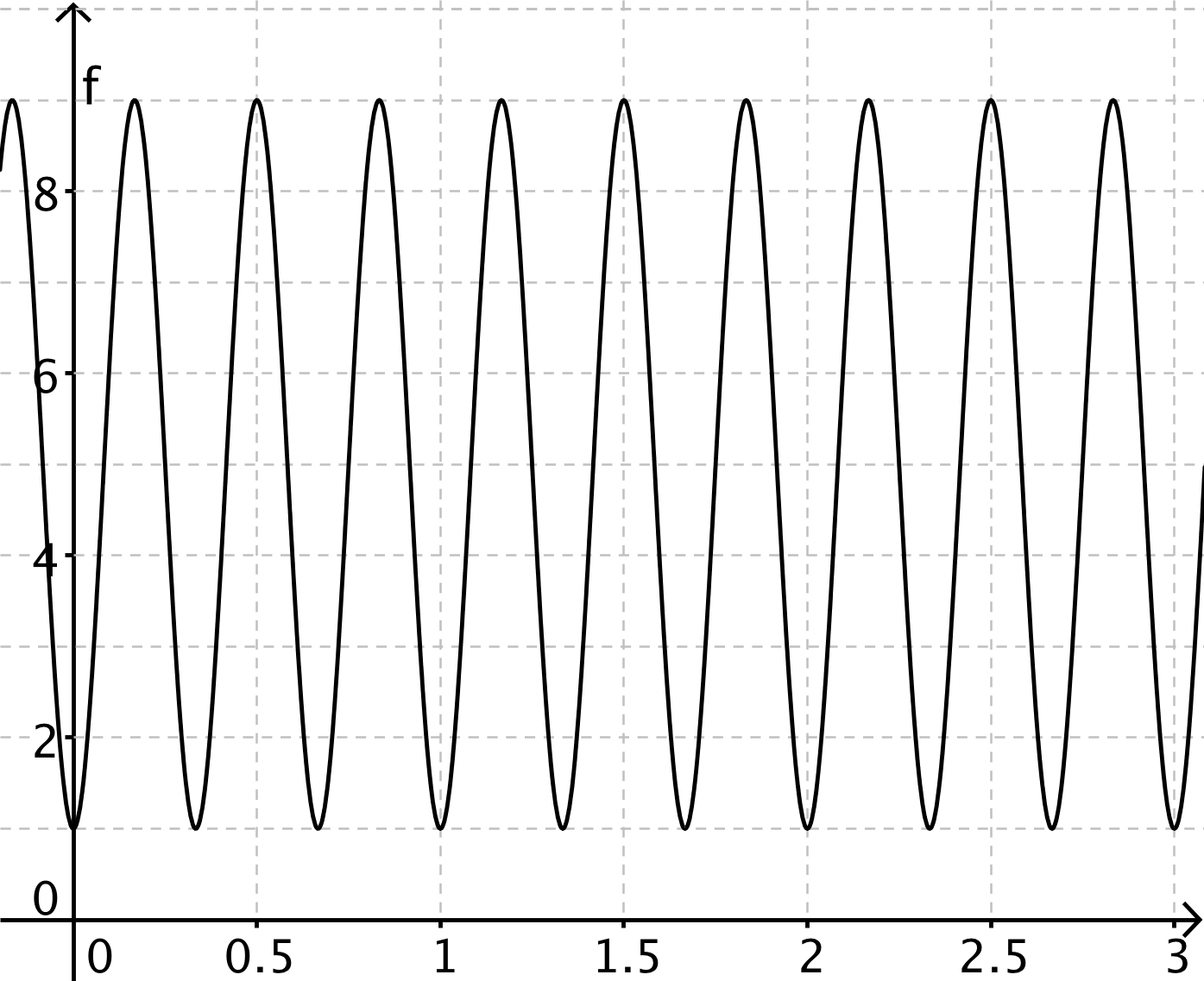
  4. The graph of \(f(t)\) in FigureΒ 4.1.10 shows the height of a rider on a Ferris wheel, with the \(y\)-axis in meters and the \(t\)-axis in minutes.
    A graph of a rapidly oscillating trigonometric function on a coordinate grid. The function oscillates between approximately y = 1 and y = 9 with many repeating peaks and troughs over the interval from x = 0 to x = 3. There are minimums at (0,1) and (3,1).
    Figure 4.1.10.
    1. Write an equation for the function \(f(t)\text{.}\)
    2. Assuming the rider boarded the Ferris wheel at \(t=0\) and finished the ride at \(t=3\text{,}\) describe the rider’s experience, including how high off the ground she boarded the Ferris wheel, how long it took the wheel to make one complete turn, the number of turns of the wheel during her ride, and the maximum height she reached on the ride.
    3. Draw a diagram of the Ferris wheel, and put the origin at ground level under the center of the Ferris wheel.
    4. Write parametric equations \((x(t), f(t))\) that describe the rider’s position at time \(t\) minutes.
    5. How far is the rider from the boarding location at \(t=0.25\) minutes into the ride?
  5. The temperature in an oven varies sinusoidally. If the temperature is set to 300\(^{\circ}\text{,}\) the oven will turn on when the temperature is 290\(^{\circ}\) and turn off when the temperature is 310\(^{\circ}\text{,}\) and this cycle takes 6 minutes.
    1. If the temperature of the oven is 300\(^{\circ}\) at 12 noon, write a function equation that models the temperature of the oven \(t\) minutes after 12 noon.
    2. What will the temperature be at 12:45 pm?
    3. What is the first time the temperature will reach 308\(^{\circ}\text{?}\) When is the second time?
  6. Let \(Z(x)=\frac{(x+3)(x-4)}{x-1}\text{.}\)
    1. What is the domain of \(Z\text{?}\)
    2. Graph \(Z\) so that the important features are visible, and label them.
    3. Describe the interval(s) on which \(Z\) is increasing.
    4. Find the average rate of change of \(Z\) on the interval \(-5 \leq x \leq -4\text{.}\)
  7. Jessica is sitting 30 feet in front in a movie theater screen so that her eyes are 5 feet above the level of the bottom of the screen. The screen itself is 28 feet high. At what angle does Jessica have to look up to see the top of the screen?
  8. Point \(P=(8,17)\) and \(Q=(-2,17)\) are the endpoints of a diameter of a circle.
    1. What is the equation of the circle?
    2. What is the length of the arc of the circle between point \(P\) and point \(R=(0,13)\text{?}\)
    3. What angle is formed by a sector whose area is \(\frac{25}{12}\pi\text{?}\)
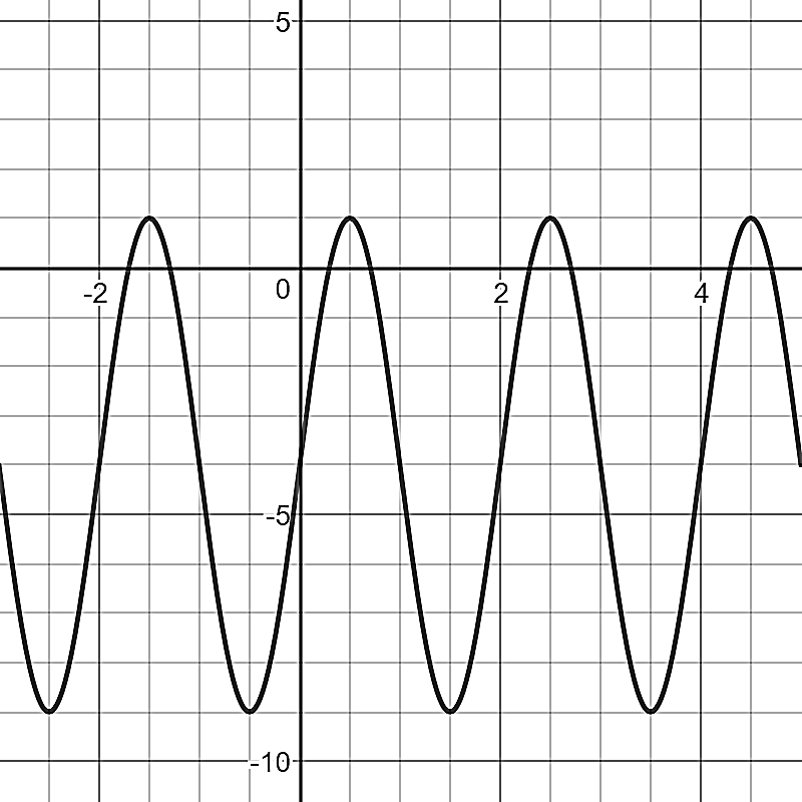
  9. The graph of \(g(t)\) is shown below.
    A graph of a periodic, wave-shaped function on a coordinate grid. The function oscillates above and below the x-axis with repeating peaks at y = 1 and troughs at y = βˆ’9. Several full cycles are shown between x = βˆ’3 and x = 5, indicating a constant amplitude and regular period.
    Figure 4.1.11.
    1. Write a function of the form \(g(t)=a\sin(b(x-h))+k\)
    2. Write a function of the form \(g(t)=a\cos(b(x-h))+k\)
  10. You take your dog to a dog park that is 100 feet by 70 feet. Your dog runs from one corner of the dog park to the corner diagonally opposite at a constant speed of 45 feet per second.
    1. Draw a diagram representing this situation and impose coordinates.
    2. How long will it take your dog to run the diagonal of the park?
    3. Write parametric equations that model the dog’s position at time \(t\text{.}\)
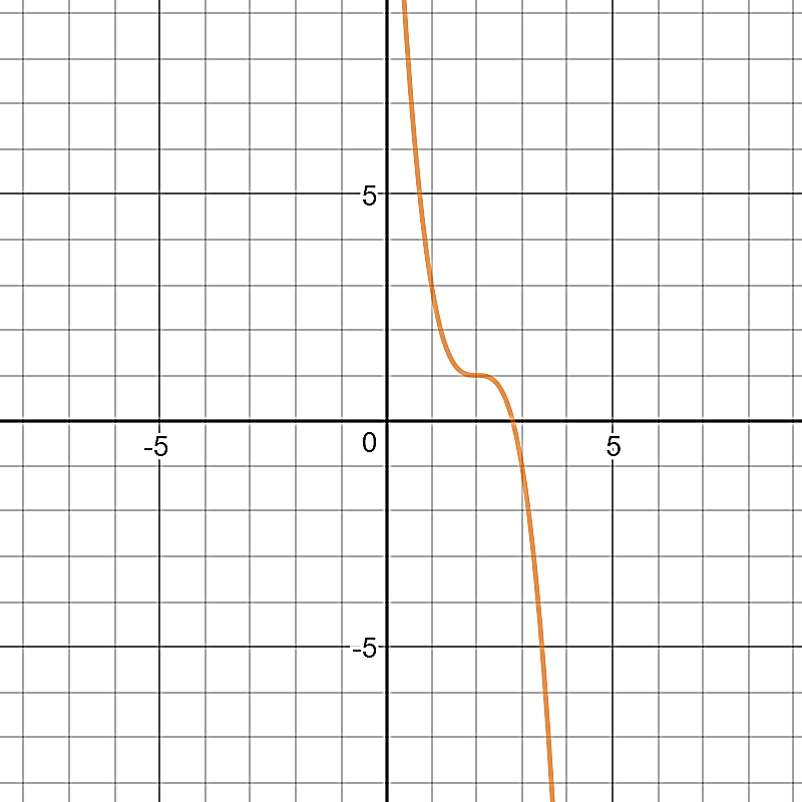
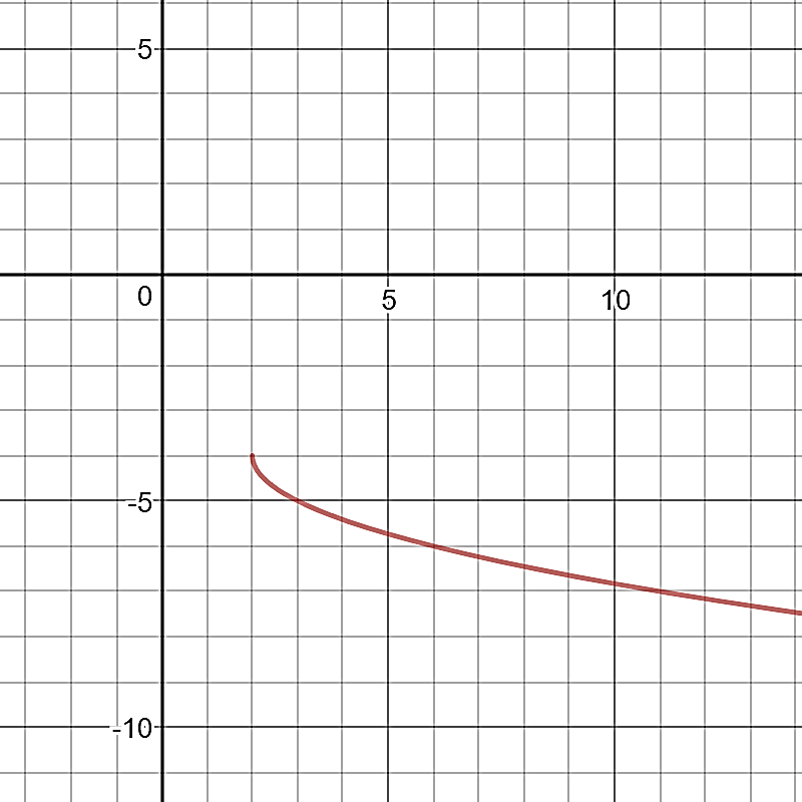
  11. For each graph given, (a) identify the function family (linear, quadratic, exponential, linear absolute value, reciprocal, square root, cubic), and (b) identify how the basic function has been transformed to produce the graph given (c) write an equation of the graph.
    A graph of a decreasing function on a coordinate grid. The curve descends steeply from the upper left, flattens briefly near (2, 1), and then continues downward to the lower right.
    A graph of a decreasing function defined for positive x-values. The curve begins near the point (2, βˆ’4) and decreases gradually as x increases, moving downward to the right.
    Figure 4.1.12.
  12. Let \(f(x)=x^3+3x^2-18x\) and \(U(x)=-5x+15\text{.}\) Sketch the graph with important points labeled.
    1. Use Desmos to solve \(f(x)=U(x)\text{.}\)
    2. Use Desmos to solve \(f(x)=40\text{.}\)
    3. Use Desmos to solve \(f(x) \leq 40\text{.}\)
    4. Use Desmos to solve \(f(x) > U(x)\text{.}\)