Section 2.1 Angles and Circles

In this section, we will learn about circles, how to measure angles in radians, and we will see a use for radian measure.
Goals:
  • F: Be able to draw a diagram incorporating all of the important information in a given situation, and impose coordinates on the diagram.
  • T: Be able to use the distance formula or the equation of a circle in context.
  • T: Be able to determine the length of an arc of a circle or the area of a sector of a circle.

Definition 2.1.1.

A circle of radius \(r\) has a circumference of \(2 \pi r\) and an area of \(\pi r^2\text{,}\) and if the center of the circle is at \((h,k)\text{,}\) then the circle is described by the equation \((x-h)^2+(y-k)^2=r^2\text{.}\)

Problem 2.1.2.

A circle has its center at \((3,-4)\text{,}\) and a radius of 5. Find the equation of the circle, the circumference of the circle, and its area.
Solution.
The solution to ProblemΒ 2.1.2 is shown below. The equation of the circle is \((x-3)^2+(y+4)^2=25\text{.}\) This circle has a circumference of \(2 \pi (5) = 10 \pi\text{,}\) and area \(\pi (5)^2 = 25 \pi\text{.}\)

Problem 2.1.3.

A circle has its center at \((-4, 8)\text{,}\) and just touches the \(y\)-axis (without crossing it).
  1. Draw a diagram of the circle in the \(xy\)-plane.
    A coordinate grid showing the x-axis labeled from -12 to 12 and the y-axis labeled from -12 to 12 in increments of 2. The origin \((0, 0)\) is at the center. Both axes have arrowheads, and the grid consists of evenly spaced squares suitable for plotting points or graphs.
    Figure 2.1.4. Blank coordinate plane with labeled axes and grid lines.
  2. Write the equation of the circle.
  3. Find the circumference and area of the circle.

Definition 2.1.7.

An arc of a circle is a piece of a circle, and has length. A sector is a part of the plane enclosed by two radii and an arc of a circle, and has area. One radian is the measure of an angle that subtends an arc of length 1 on the unit circle.
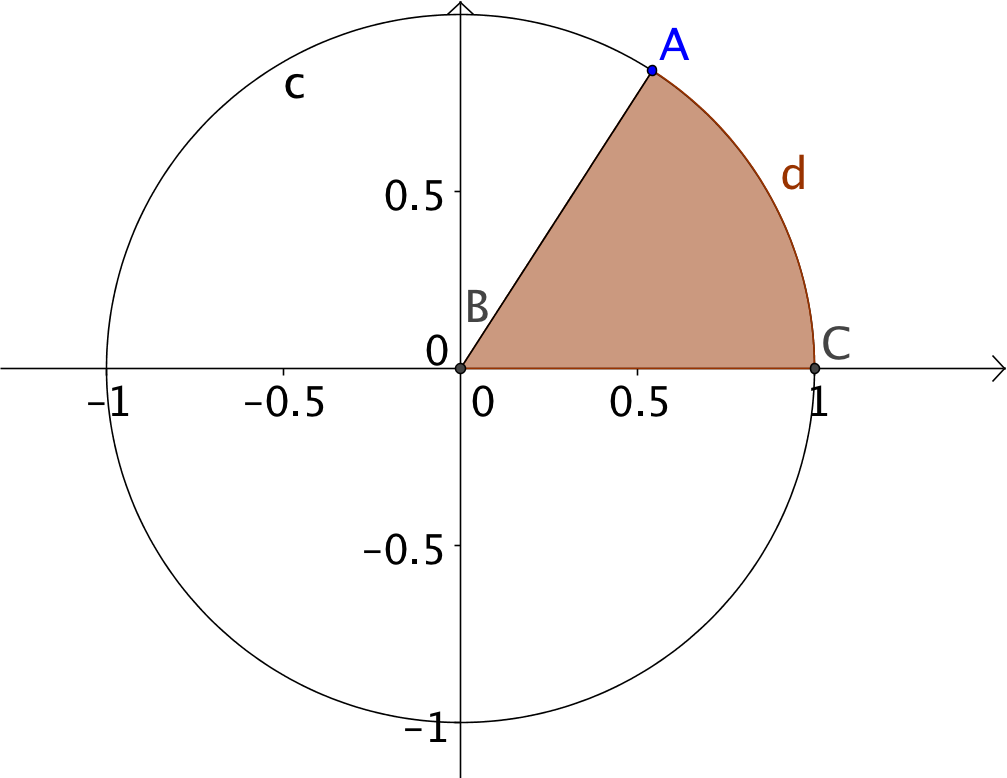
In FigureΒ 2.1.8, the unit circle is shown. In the figure, \(d\) is the arc and the shaded region is a sector. \(m \angle ABC=1\) radian, because the arc \(d\text{,}\) the distance along the circle from point \(A\) to point \(C\text{,}\) has length 1.
A unit circle centered at the origin with a shaded sector between points \(A\) and \(C\) on the circumference. The sector is bounded by radii from the origin to \(A\) and \(C\text{,}\) and the arc labeled \(d\text{.}\) The radius is 1 unit, and the circle is drawn on a coordinate grid with axes labeled from -1 to 1. Points are marked: \(A\) near the first quadrant, \(B\) at the origin, and \(C\) on the positive x-axis. The arc and sector highlight a portion of the circle.
Figure 2.1.8. Sector of a unit circle illustrating an arc
It is sometimes handy to be able to convert degree measure to radian measure. Since the circumference of the unit circle is \(2\pi\text{,}\) this means that the radian measure of an angle corresponding to a complete circle is also \(2 \pi\) radians. Suppose that an angle measures \(\alpha\) (Greek letter alpha) in degrees, but \(x\) radians. We can set up a proportion \(\frac{x}{2 \pi} = \frac{\alpha}{360}\text{.}\) If we solve for \(x\text{,}\) we have the degrees-to-radians conversion formula \(x=\frac{\pi}{180} \alpha\text{.}\)

Problem 2.1.9.

Convert the angles \(0^o\text{,}\) \(30^o\text{,}\) \(135^o\text{,}\) and \(300^o\) to radians.

Problem 2.1.10.

Convert the angles \(\frac{\pi}{6}\) radians, \(\pi\) radians and \(\frac{11 \pi}{6}\) radians to degrees.

Problem 2.1.11.

Working with arc length.
  1. What is the length of the arc along a circle of radius 7 cut out by an angle of \(90^o\text{?}\)
  2. What is the length of the arc along a circle of radius 3 cut out by an angle of \(\frac{\pi}{6}\) radians?
  3. What is the length of the arc along a circle of radius 5 cut out by an angle of \(240^o\text{?}\)

Problem 2.1.12.

Working with sector area.
  1. What is the area of the sector cut out of a circle of radius 7 by an angle of \(\frac{\pi}{3}\) radians?
  2. What is the area of the sector cut out of a circle of radius 3 by an angle of \(45^o\text{?}\)
  3. What is the area of the sector cut out of a circle of radius 5 by an angle of \(\frac{3\pi}{2}\) radians?

Problem 2.1.13.

You are at a picnic when you notice an ant crawling along the edge of your 9-inch circular apple pie. The ant enters the rim of the pie plate at the 3 o’clock position and walks at a constant rate around the rim of the pie plate to the 11 o’clock position, where he exits the pie plate.
  1. Draw a diagram of the ant’s path.
  2. How far did the ant walk on the rim of the pie plate?
  3. If the ant walks 1.5 inches per second, how long did it take it to walk from the 3 o’clock position to the 11 o’clock position on the pie plate.
  4. If your pie is cut into 8 equal pieces, find the area of the top one piece.
  5. Your brother has an 8-inch circular chocolate pie that is cut in 7 pieces. He wants to trade you one piece of apple pie for one piece of chocolate pie. Is this a fair trade?
  6. How far would the ant have walked if he walked in a straight line across the pie instead of along the rim?