Skip to main content\(
\newcommand{\lt}{<}
\newcommand{\gt}{>}
\newcommand{\amp}{&}
\definecolor{fillinmathshade}{gray}{0.9}
\newcommand{\fillinmath}[1]{\mathchoice{\colorbox{fillinmathshade}{$\displaystyle \phantom{\,#1\,}$}}{\colorbox{fillinmathshade}{$\textstyle \phantom{\,#1\,}$}}{\colorbox{fillinmathshade}{$\scriptstyle \phantom{\,#1\,}$}}{\colorbox{fillinmathshade}{$\scriptscriptstyle\phantom{\,#1\,}$}}}
\)
Subsection 1.1 Representing Mathematical Relationships Exercises
-
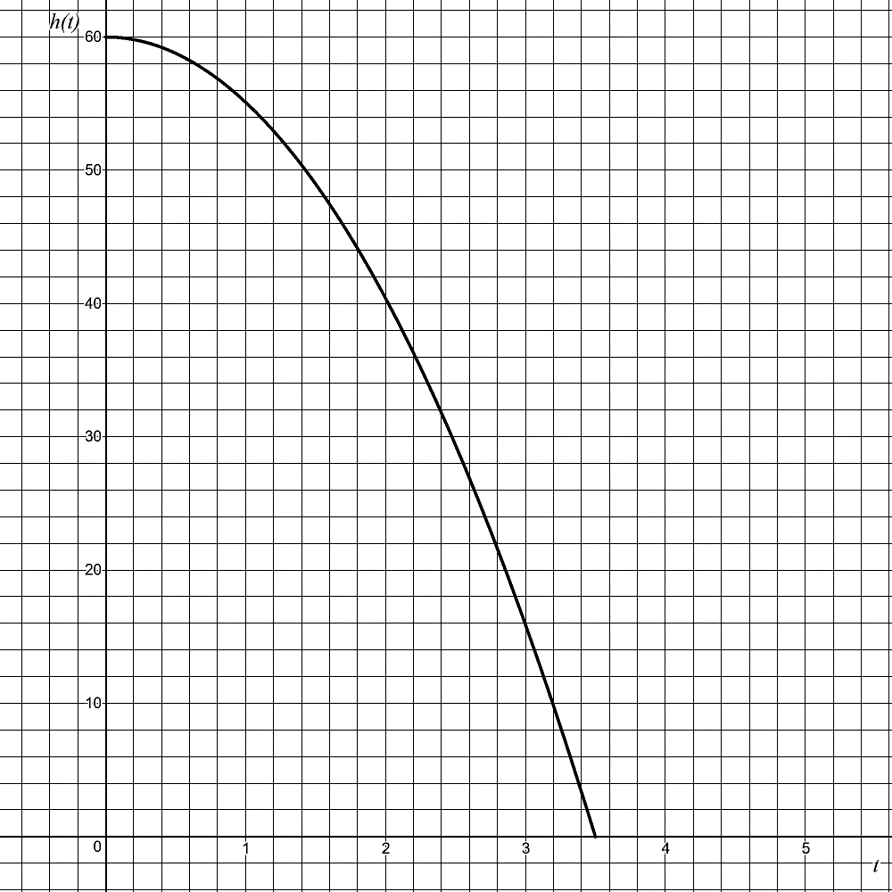
The height above ground, \(h\text{,}\) of a ball \(t\) seconds after being dropped off a 60 meter tall building is given by the equation
\begin{equation*}
h(t)=-4.9t^2+60
\end{equation*}
and shown on the graph below.
Figure 1.1.13.
-
How high is the ball at
\(t=2\) seconds?
-
How long does it take the ball to hit the ground?
-
When is the ball at a height of 10 meters?
-
When will the height of the ball be greater than 10 meters?
-
Using the graph, estimate the height of the ball at
\(t=1\) second, then use the equation for
\(h(t)\) above to find the exact value.
-
Using the graph, estimate at what time the ball will be a height of 20 meters, then use the formula for
\(h\) above to find the exact value.
-
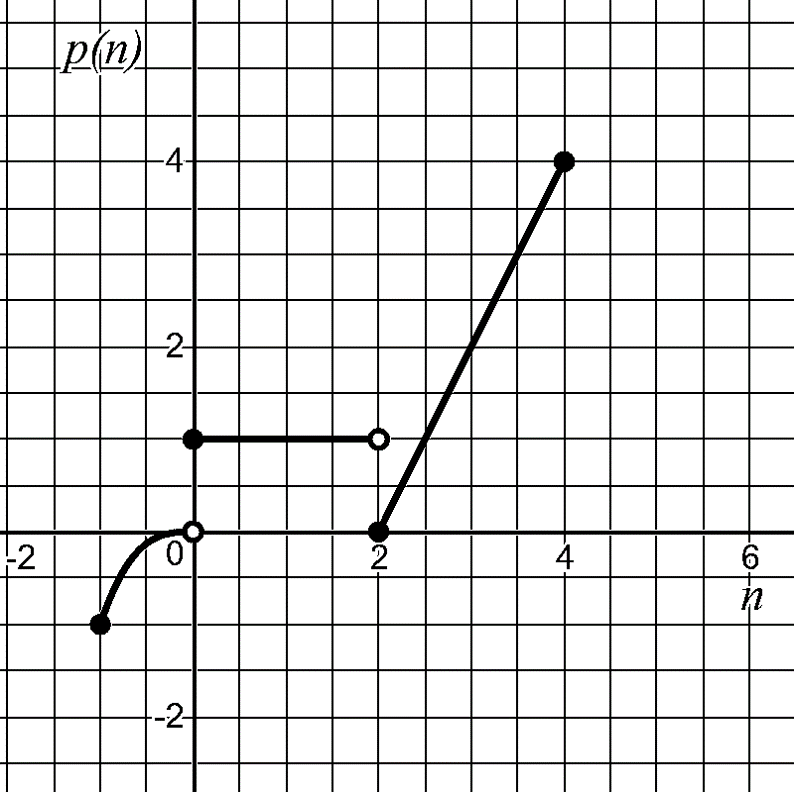
Use the graph of
\(p(n)\) below to answer the following questions.
-
-
-
Solve
\(p(n)=-1\text{.}\)
-
-
For which values of
\(n\) is
\(p(n)=1\text{?}\)
-
Solve
\(p(n)\geq 2\text{.}\)
-
Use Desmos to graph the function
\(f(x)=4x^3+10x^2-1\) and answer the following questions.
-
Evaluate
\(f(-1)\text{.}\)
-
Solve
\(f(x)=-1\text{.}\)
-
-
Solve
\(f(x) \geq -1\text{.}\)
-
Solve
\(f(x) < 4\text{.}\)
-
Evaluate each function for the indicated value or expression.
-
\(v(t)=5t^2-3t+4\text{,}\) \(v(-3)\)
-
\(q(n)=-4 \cdot (-4)^{n^2}\text{,}\) \(q(-3)\)
-
\(b(x)=5x+3\text{,}\) \(b(-2x+4)\)
-
\(z(x)=\frac{x^2+1}{x+1}\text{,}\) \(z(4x)\)