Skip to main content
Contents Dark Mode Prev Up Next \(
\newcommand{\lt}{<}
\newcommand{\gt}{>}
\newcommand{\amp}{&}
\definecolor{fillinmathshade}{gray}{0.9}
\newcommand{\fillinmath}[1]{\mathchoice{\colorbox{fillinmathshade}{$\displaystyle \phantom{\,#1\,}$}}{\colorbox{fillinmathshade}{$\textstyle \phantom{\,#1\,}$}}{\colorbox{fillinmathshade}{$\scriptstyle \phantom{\,#1\,}$}}{\colorbox{fillinmathshade}{$\scriptscriptstyle\phantom{\,#1\,}$}}}
\)
Subsection 2.5 Exponents and Radicals Exercises
Let
\(p(x)=x^2\text{,}\) \(q(x)=-5^x\text{,}\) \(r(x)=5^{x-3}\text{.}\) Write a formula for each function below, using the exponent rules to simplify the formula and write without negative exponents.
\(\displaystyle a(x)=p(q(x))\)
\(\displaystyle b(x)=2q(x)r(x)\)
\(\displaystyle c(x)=(q(x))^{-3}\)
\(\displaystyle d(x)=5\left(\frac{q(x)}{r(x)}\right)^3\)
Let
\(f(x)=\sqrt{x^2}\text{,}\) \(g(x)=\sqrt[3]{x^3}\text{,}\) \(h(x)=\sqrt[4]{x}\text{,}\) and
\(k(x)=x^4\text{.}\)
True or false: For all real values
\(x\text{,}\) \(f(x)=g(x)\text{.}\) Explain your answer.
True or false: For all real values
\(x \geq 0\text{,}\) \(f(x)=k(h(x))\text{.}\) Explain your answer.
True or false: For all real values
\(x \geq 0\text{,}\) \(h(k(x))=k(h(x))\text{.}\) Explain your answer.
True or false: For all real values
\(x\text{,}\) \(f(x)=h(k(x))\text{.}\) Explain your answer.
Let
\(m(x)=x^{\frac{1}{6}}\text{,}\) \(n(x)=x^3\text{,}\) and
\(p(x)=x^4\text{.}\)
Write
\(m(n(x))\) as a function of
\(x\) with a single exponent.
Write
\(m(n(x)p(x))\) as a function of
\(x\) with a single exponent.
For what values of
\(x\) is
\(m(p(x))=x^{\frac{2}{3}}\text{?}\) Explain.
For what values of
\(x\) is
\(\sqrt[3]{n(x)}=x\text{?}\) Explain.
For what values of
\(x\) is
\(3\cdot2^x=6^x\text{?}\) Explain.
Is it ok to simplify
\(3\cdot2^x\) into
\(6^x\text{?}\) Explain.
Write each expression as a sum of powers.
\(\displaystyle \frac{x^3-4x^2+7x}{\sqrt{x}}\)
\(\displaystyle x^{\frac{2}{3}}(3x^5-6x^{\frac{5}{3}}-9x\sqrt[3]{x})\)
\(\displaystyle x^{\frac{5}{2}}(-8x^2+5x^{\frac{3}{2}}-10\sqrt{x}+4)\)
Let
\(g(x)=-\frac{1}{2}x^2+4x-6\text{.}\)
Find the
\(x-\) and
\(y-\) intercepts of
\(g(x)\text{.}\)
Find the vertex of
\(g(x)\text{.}\)
Use
Item 6.a and
Item 6.b to graph
\(g(x)\text{.}\) Use Desmos to check your answer.
Solve algebraically:
\(g(x)=-2.5\text{.}\) Use Desmos to check your answer.
Solve algebraically:
\(g(x)=1.5\text{.}\) Use Desmos to check your answer.
Solve
\(g(x) < -6\text{.}\)
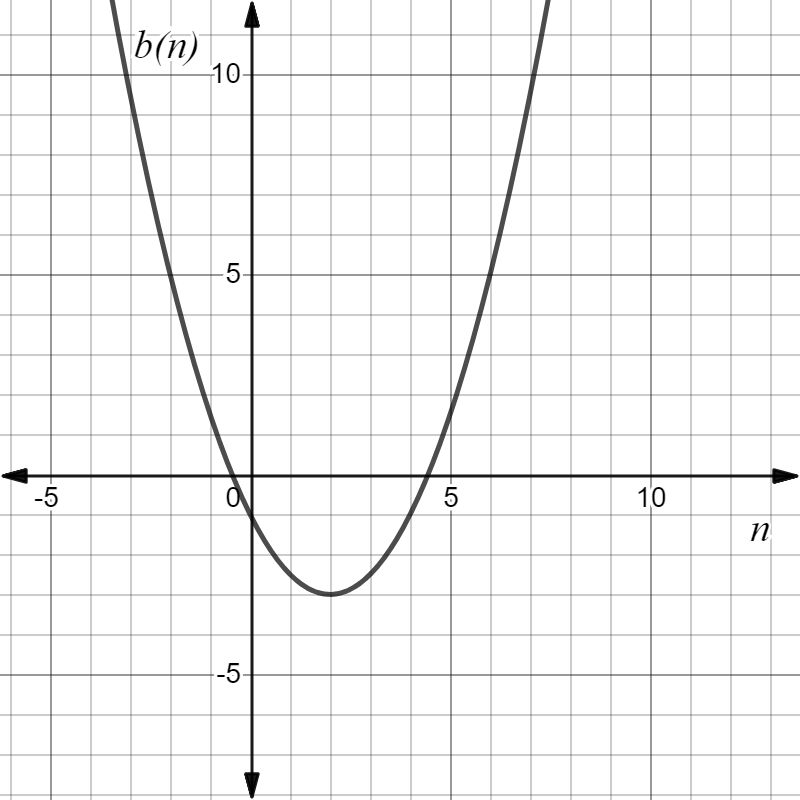
The graph of
\(b(n)\) is shown below.
Figure 2.5.7. Graph of the function \(b(n)\text{.}\)
Evaluate
\(b(0)\text{.}\)
Solve
\(b(n) \leq 5\text{.}\)
Write a function equation for
\(b(n)\text{.}\)
Use your equation to find the
\(n-\) intercepts of
\(b\text{.}\)
The number of computer science degrees awarded by Monroe College has increased by a factor of 1.5 every 5 years since 1984. The college granted 8 degrees in 1984.
Write a formula for the number of degrees awarded
\(t\) years after 1984.
If the number of degrees awarded continued to increase exponentially, how many degrees were awarded in 2000?
If the number of degrees awarded continues to increase exponentially, in what year will 200 degrees be awarded?