Subsection 1.2 Linear Function Exercises

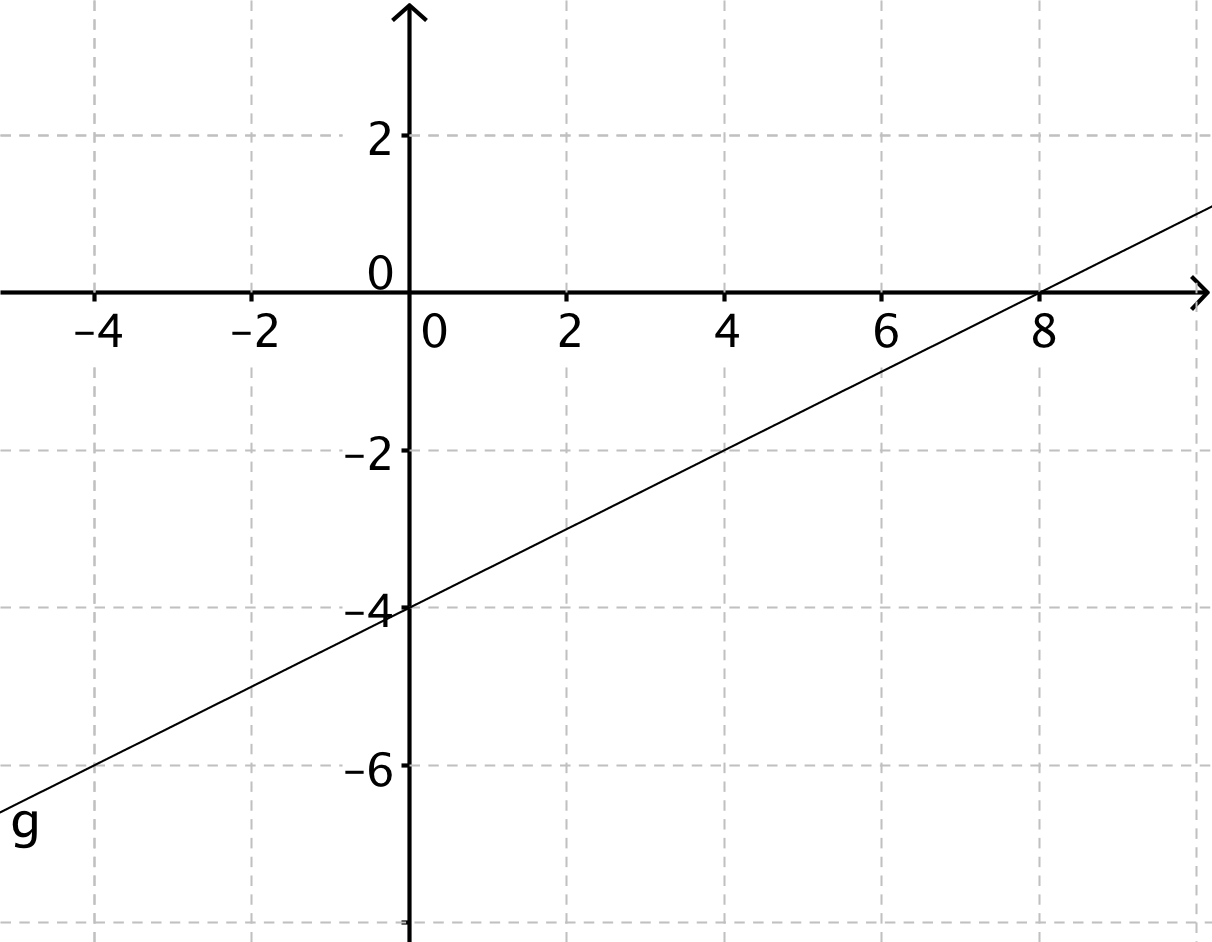
  1. Refer to the graph of \(g(x)\) below.
    An increasing linear function that crosses the y-axis at negative 4 and the x-axis at 8.
    Figure 1.2.15.
    1. What is \(g(3)\text{?}\)
    2. Solve \(g(x)=0\text{.}\)
    3. Write a function equation for \(g(x)\text{.}\)
    4. Use your function equation for \(g(x)\) to find \(g(3)\text{.}\) Does this match your answer to ItemΒ 1.a?
    5. What are some advantages and disadvantages of representing functions as graphs vs representing functions as equations?
  2. Let \(p(x)=-3x+12\text{.}\)
    1. Graph \(p(x)\) on the domain \(-3 \leq x \leq 5\text{.}\) Label the intercepts.
    2. Solve \(p(x)=0\) for \(x\) using the function equation.
    3. What is \(p(-2)\text{?}\)
  3. For each linear function below, find the slope, and write equations of the line in point-slope and slope-intercept form.
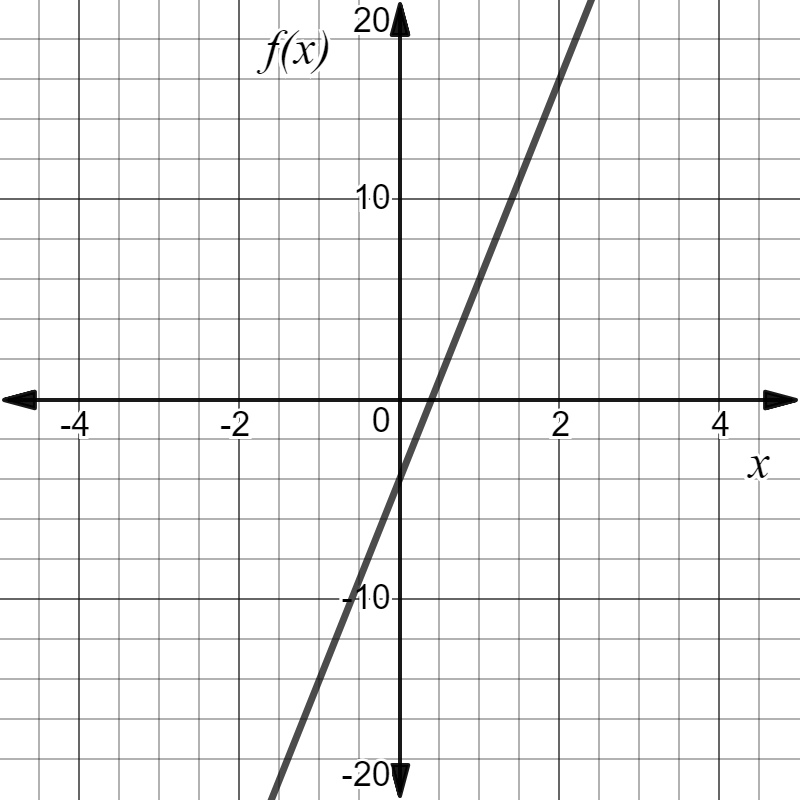
    1. \(f\) as shown in the graph below.
      A coordinate plane with the horizontal axis labeled x and the vertical axis labeled f of x. The graph crosses the y-axis at negative 4 and goes through the point \((3, -14)\text{.}\)
      Figure 1.2.16.
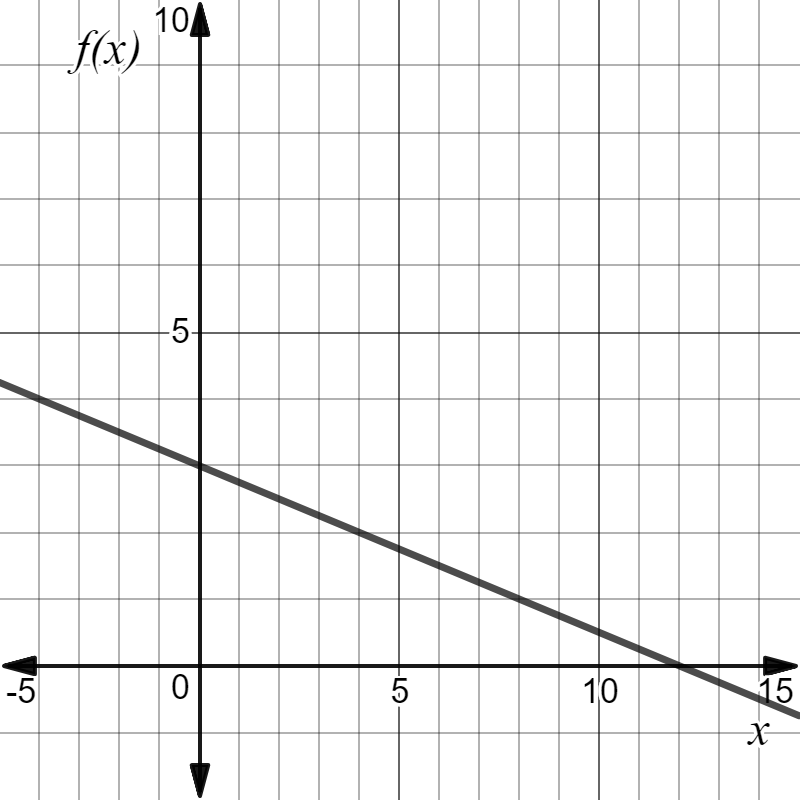
    2. \(f\) as shown in the graph below.
      The x-axis is marked from βˆ’5 to 15 and the y-axis is marked from 0 to 10. A straight line with negative slope is shown, decreasing from left to right, crossing the vertical axis y equals 3 and crossing the horizontal axis at x equals 12.
      Figure 1.2.17.
    3. Table 1.2.18.
      \(x\) \(-1\) 0 1 2 3
      \(g(x)\) 5 2 \(-1\) \(-4\) \(-7\)
    4. Table 1.2.19.
      \(t\) \(-1\) 0 1 2 3
      \(n(t)\) \(-0.75\) \(-0.5\) \(-0.25\) 0 0.25
  4. Given two points below, write an equation of the line in point-slope form. Then write an equation of the line in slope-intercept form and use your equation to identify the vertical intercept.
    1. \((-2, -14)\text{,}\) \((0, -2)\)
    2. \((0, -1)\text{,}\) \((1, 0)\)
    3. \((-11, 6)\text{,}\) \((4, -5)\)
  5. Let \(k(x)=4x\text{,}\) \(j(x)=-3x+4\text{,}\) \(m(x)=-4(x-2)-3\text{.}\)
    1. Evaluate \(m(-2)\)
    2. Evaluate \(m(0)\)
    3. Solve \(j(x)=-2\)
    4. Solve \(k(x)=m(x)\)
    5. Solve \(j(x) \leq -1\)
    6. Solve \(m(x) > 0\)
    7. Solve \(m(x) < k(x)\)
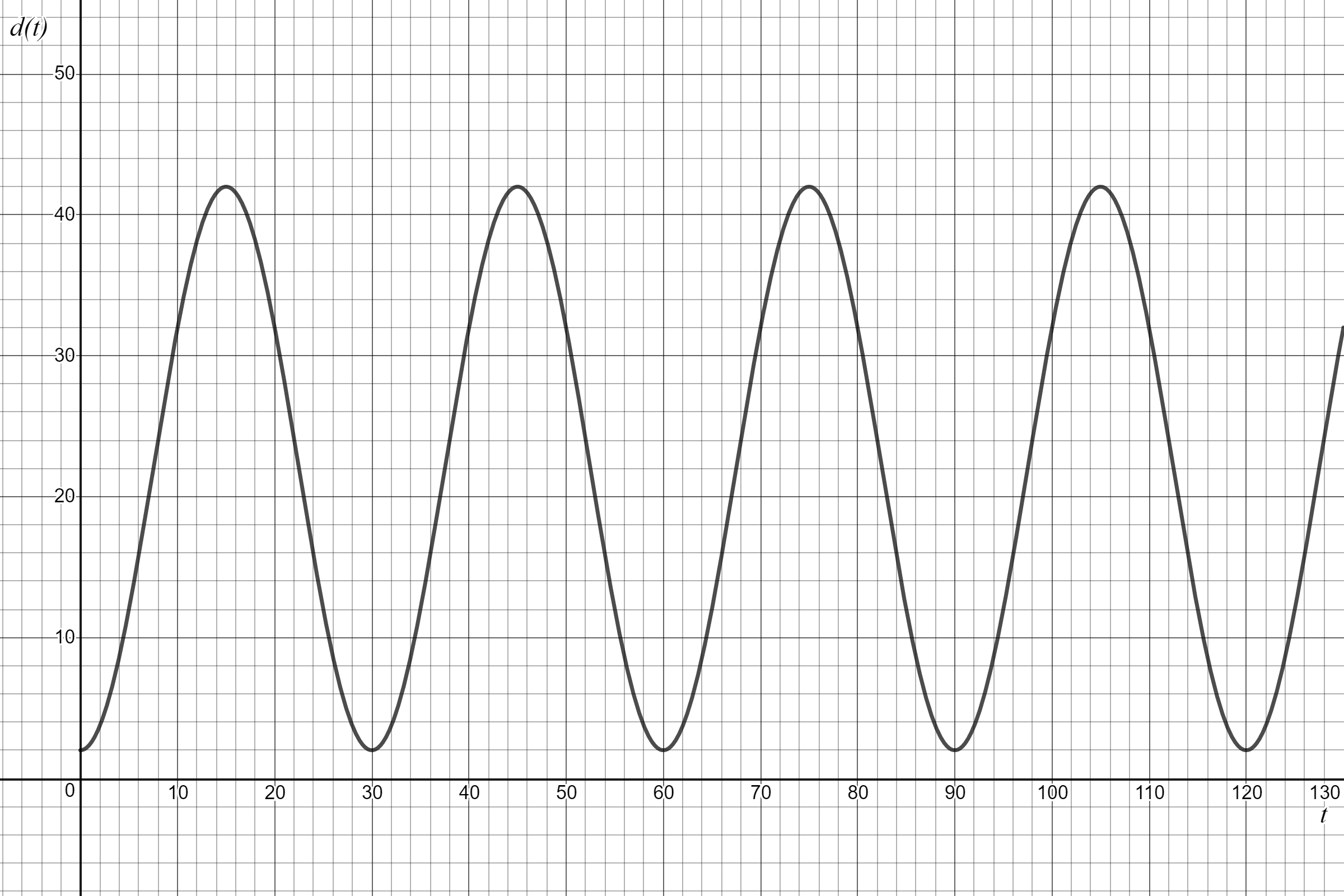
  6. See the graph of \(d\) below.
    A coordinate plane with the horizontal axis labeled t and the vertical axis labeled d of t. The graph shows a smooth periodic curve that oscillates between low values near zero and high values slightly above forty. The pattern repeats at regular intervals as t increases, indicating a repeating cycle over time.
    Figure 1.2.20.
    1. What is the maximum height reached by the rider of the Ferris wheel? What are the first two times this maximum occurs?
    2. What is the minimum height reached by the rider of the Ferris wheel? What are the first two times this minimum occurs?
    3. How long does it take the rider to travel make one complete revolution on the Ferris wheel?
    4. Find four times the rider is at a height of 32 feet?
    5. During the first 30 seconds, when is height of the rider at least 32 feet?
    6. Solve \(d(t)<32\) on the interval [0, 30].
  7. Refer to FigureΒ 1.2.21, Triangle Pattern. Assume that each edge of the triangle measures 1 cm. Assume that one triangle is added to one figure to get the next figure. Let \(P\) be the function describing the perimeter as a function of the figure number.
    A comparison of two growing shape patterns: on the left, a triangle pattern that grows by adding triangular units in rows; on the right, a hexagon pattern that grows by adding one hexagon at a time in a chain.
    Figure 1.2.21. Triangle and hexagon growth patterns.
    1. Draw the next two figures in the pattern.
    2. Make a table with columns for \(n\) and \(P(n)\) for \(1\leq n \leq 5\text{.}\)
    3. Make a graph of the values in your table.
    4. Write an equation for \(P(n)\text{.}\)
    5. Find \(P(12)\text{.}\)
    6. How many triangles are in a figure with a perimeter of 18?
  8. Refer to FigureΒ 1.2.21, Hexagon Pattern. Assume that each edge of the hexagon measures 1 cm. Assume that one hexagon is added to one figure to get the next figure. Let \(H\) be the function describing the perimeter as a function of the figure number.
    1. Draw the next two figures in the pattern.
    2. Make a table with columns for \(n\) and \(H(n)\) for \(1\leq n \leq 5\text{.}\)
    3. Make a graph of the values in your table.
    4. Write an equation for \(H(n)\text{.}\)
    5. Find \(H(15)\text{.}\)
    6. Solve \(H(n)=38\text{.}\)
  9. MovieTicket is offering a discount plan where if you subscribe to the plan for $20 per month, you can purchase as many movie tickets as you want for $5 instead of the regular price of $11. How many movies must you see a month to make it worth signing up for the plan?
  10. A sandwich shop charges $7 for a foot-long sandwich with one protein and unlimited veggies. You can add additional proteins for $1.50 per protein.
    1. Write a linear function equation that models \(S\text{,}\) the cost of a sandwich, as a function of \(t\text{,}\) the number of toppings on the sandwich.
    2. The ’Monster Meat’ sandwich has all 7 of the proteins that the sandwich shop has available. How much will this cost?
    3. If your sandwich cost $13, how many proteins did it have?
    4. Consider your linear function from ItemΒ 10.a. What domain and range make sense in the context of this problem?
  11. Sally needs to choose between two internet plans. Under the first plan Verizon will sell her a DSL modem for $17.99, then she must pay $12.99 per month. Under the second plan, ATT will give her a modem for free, but she must pay $14.99 per month.
    1. When does the Verizon plan become the better deal (how many months)?
    2. Describe at least one other possible solution method for ItemΒ 11.a besides the one you used.
  12. Barbara is visiting another county and wants to know the sales tax rate. She just bought a pair of shorts for $22 and paid $1.87 in sales tax.
    1. What tax will she pay if she buys sunblock for $8?
    2. What is the sales tax rate?
    3. Write a function equation that computes the tax as a function of the item price.
  13. The U.S. is nearly the last country to use the English system of measurement, which includes the Fahrenheit scale for temperature instead of the Celsius scale. There are two conversion formulas, one from Celsius to Fahrenheit, and one from Fahrenheit to Celsius. One of the two formulas is \(F=\frac{9}{5}C+32\text{,}\) where \(F\) is the temperature in degrees Fahrenheit, and \(C\) is the temperature in degrees Celsius.
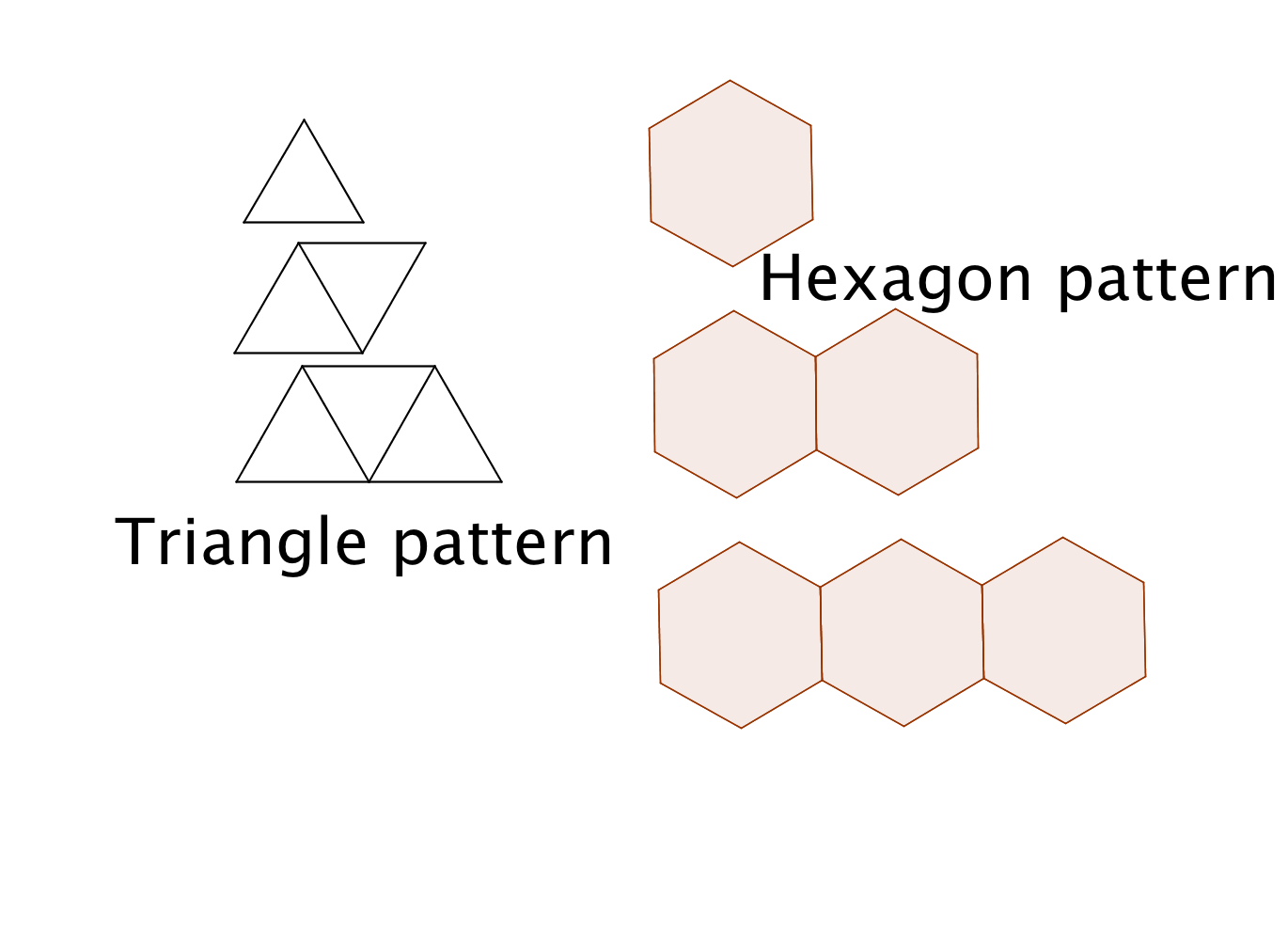
    Table 1.2.22. Temperature conversions
    Temp (\(^o F\)) 59 68 77 86 95
    Temp (\(^o C\)) 20
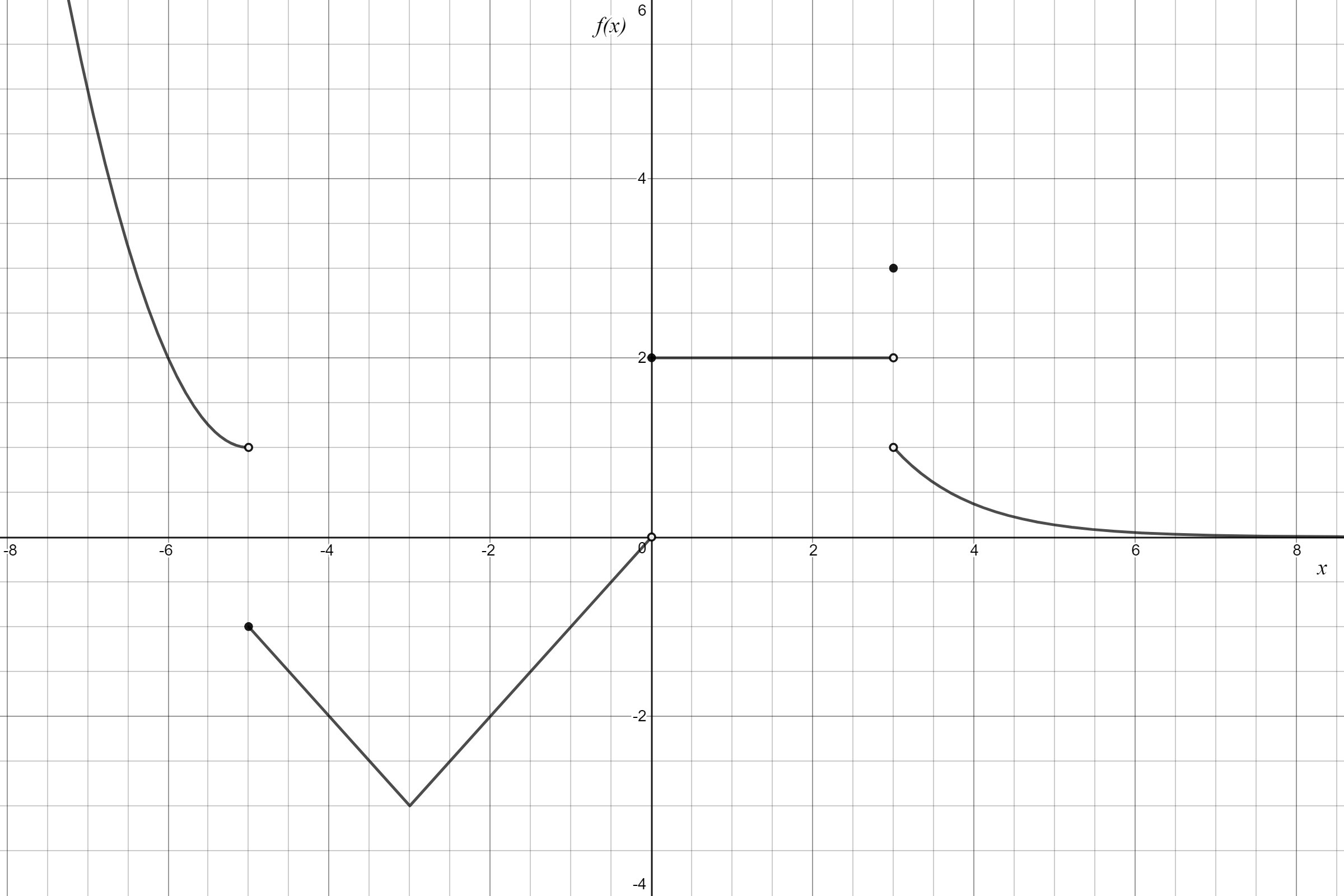
  14. The graph of \(f\) is shown below.
    A coordinate plane with the horizontal axis labeled x and the vertical axis labeled f of x. The graph consists of multiple pieces, including a curved segment in the upper left ending at an open circle, a V-shaped line segment below the x-axis with a closed point on the left and an open point at the origin, a horizontal segment at y equals two starting at the vertical axis and ending at an open circle, a single filled point above that segment, and a decreasing curved segment to the right beginning at an open circle and approaching the x-axis.
    Figure 1.2.23.
    1. Evaluate \(f(-4)\)
    2. Evaluate \(f(-5)\)
    3. Evaluate \(f(3)\)
    4. Solve \(f(x)=5\)
    5. Solve \(f(x)=-2\)
    6. Solve \(f(x)=2\)
    7. Solve \(f(x)=0\)
    8. Solve \(f(x)>5\)
    9. Solve \(f(x) \leq -2\)