One student solved the problem this way: \(100 \times 1.025 \times 1.025 \times 1.025 = 107.69\text{.}\)\(107.69-100=7.69\text{.}\) So the answer is \(7.69\%\text{.}\) Explain this student’s work. What does \(7.69\%\) represent in this problem?
Maria is preparing envelopes for mailing. Maria has already prepared 50 envelopes this morning. At 1 pm, she returns from lunch. She can prepare 110 envelopes per hour.
Recall that the vertical position of falling objects can be modeled by the equation \(h(t)=-16t^2+vt + c\text{,}\) where \(t\) is the time in seconds, \(h(t)\) is the height in feet, \(c\) is the initial height of the object, and \(v\) is the initial velocity of the object. A football is kicked from a height of 3 feet above the ground and has an initial velocity of 60 feet per second. [Note: Footballs are affected by air resistance (wind, etc), so this is not a very accurate model. There are more complicated models that take these factors into account.]
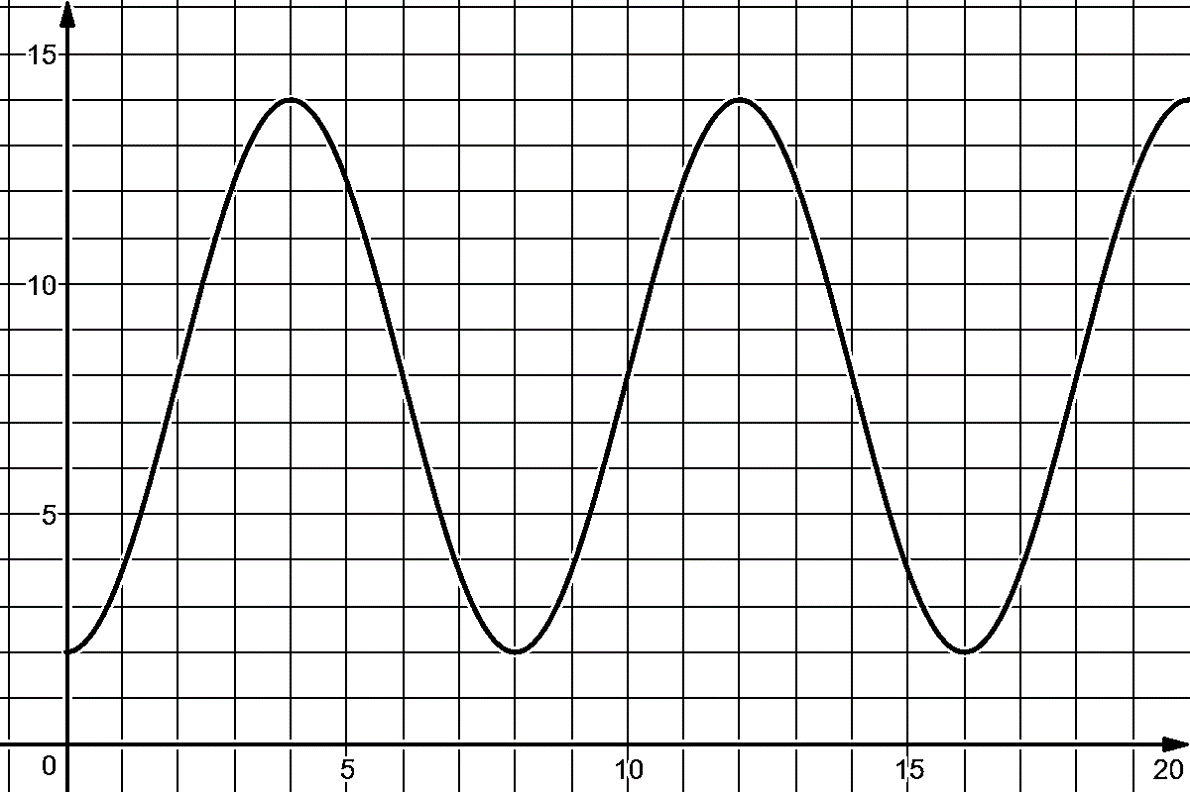
The graph below shows the height above ground, \(h\) (in meters), of a Ferris wheel rider \(t\) seconds after her ride starts (when she is at the 6 o’clock position on the wheel).