
Subsection 2.4 Combining Functions Exercises

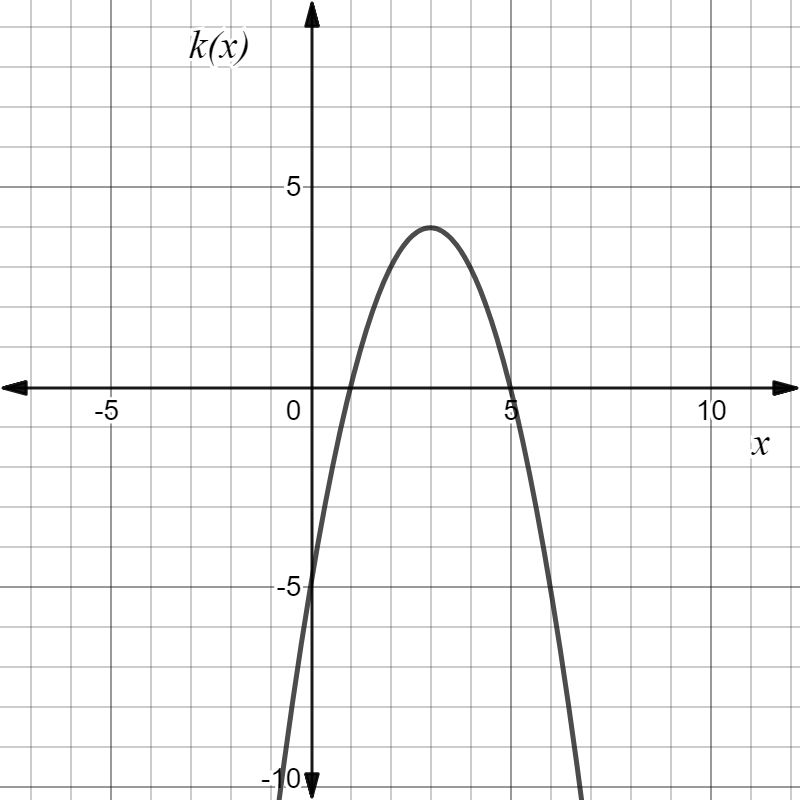
  1. Let \(q(x)=x-2\text{.}\) Use the graph of \(k(x)\) and the table of \(p(x)\) shown below and the equation of \(q(x)\) to answer the following questions.
    A coordinate grid with axes labeled x and k(x). The graph shows a downward-opening parabola. The curve reaches a maximum at \((3,4)\text{,}\) then decreases on both sides. It crosses the x-axis at x equals 1 and x equals 5 and crosses the y-axis at k(x) equals minus 5.
    \(x\) \(-4\) \(-2\) 0 2 4
    \(p(x)\) 1 2 3 4 5
    (a) Table for \(p(x)\)
    Figure 2.4.13. Graph of \(k(x)\) and table of values for \(p(x)\text{.}\)
    1. Let \(f(x)=(k \circ p)(x)\) Evaluate \(f(-2)\text{.}\)
    2. Solve \(f(x)=4\) for \(x\text{.}\)
    3. Let \(g(x)=q(k(x))\text{.}\) Evaluate \(g(0)\text{.}\)
    4. Solve \(g(x)=1\) for \(x\text{.}\)
    5. Let \(a(x)=p(x)-2q(x)\text{.}\) Evaluate \(a(-4)\text{.}\)
    6. Let \(b(x)=\frac{k(x)}{(q(x))^2}\text{.}\) Evaluate \(b(6)\text{.}\)
    7. What is the average rate of change of \(p\) on the interval \([-4, 2]\text{?}\)
  2. Let \(v(t)=3t-4\text{,}\) \(p(t)=e^{3t}\text{,}\) \(n(t)=t^2-1\text{.}\) Find an algebraic formula for each function below.
    1. \(\displaystyle c(t)=v(p(t))\)
    2. \(\displaystyle h(t)=p(v(t))\)
    3. \(\displaystyle d(t)=n(v(t))\)
    4. \(\displaystyle k(t)=v(n(t))\)
    5. \(\displaystyle e(t)=-v(t)+2(n(t))\)
    6. \(\displaystyle f(t)=\frac{n(t)}{v(t)}\)
    7. \(\displaystyle g(t)=v(t) \cdot n(t)\)
  3. For each function below, determine functions \(f\) and \(g\) so that the function can be written as an operation (sum, difference, product, etc) or composition of \(f\) and \(g\text{.}\)
    1. \(\displaystyle r(x)=(3x+1)^2\)
    2. \(\displaystyle s(x)=2 \sqrt{x} - \frac{1}{\sqrt{x}}\)
    3. \(\displaystyle q(x)=\frac{e^x}{x^2-1}\)
    4. \(\displaystyle w(x)=x^2 \cdot e^{x^2}\)
    5. \(\displaystyle y(x)=x^3 \cdot e^{x^2}\)
  4. Cell phones begin to lose (resale) value immediately after purchase. After one year, an iPhone can be resold at 63% of its list price. Assume that each year after that, the resale value continues to drop to 63% of the resale price from the previous year.
    1. Assuming the list price of an iPhone is $649, write an exponential model for the resale price, \(P(t)\text{,}\) of an iPhone \(t\) months after purchase.
    2. According to your model, what is the resale value of the iPhone after 18 months?
    3. According to your model, when is the resale value of the iPhone $150?
    4. Assume that a particular Android phone has a value, \(A(t)\text{,}\) that is always $100 less than the iPhone. Write \(A(t)\) as a composition of \(P(t)\) and another function, \(h(t)\text{,}\) so that \(A(t)=h(P(t))\text{.}\)
  5. Consider the functions \(k(x)=8^x\) and \(m(x)=4\cdot 2^x\text{.}\)
    1. Are \(k(x)\) and \(m(x)\) the same function? Explain.
    2. Write \(m(x)\) as a composition of \(f(x)=2^x\) and another function \(b(x)\text{,}\) so that \(m(x)=b(f(x))\text{.}\)
    3. Write \(k(x)\) as a composition of \(f(x)=2^x\) and another function \(d(x)\text{,}\) so that \(k(x)=d(f(x))\text{.}\)
  6. A new sofa cost $1200 in 2010. The value of the couch decreases by 15% per year.
    1. Write a formula for the value of the couch \(t\) years after 2010.
    2. If the cost continues to decrease exponentially, what will the value of the sofa be in 5 years?
    3. If the cost continues to decrease exponentially, how long will it take for the couch to reach half of its original price.
    4. How much does the value of the couch decrease per year in the first five years?
  7. Adam, the farmer, is building a third rectangular enclosure, this one for his cows and bulls. He has 600 feet of fencing. He wants to enclose all four walls with fence, but he also wants to build another wall of fencing through the middle of the enclosure to separate the cows from the bulls. As before, he wants to use his fencing to give the animals as much total area as possible.
    1. Draw a diagram showing the enclosure with the dividing fence, and label one of the sides of the wire fencing as \(x\text{.}\)
    2. Write an equation for the area of the enclosure in terms of \(x\text{.}\)
    3. How should the fencing be used to get the maximum possible area? Assuming each gets half of the space, how much area will the cows and the bulls each get?
  8. Let \(f(x)=-2x-5\) and \(g(x)=x^2+6x+2\text{.}\) Solve each inequality below algebraically.
    1. \(\displaystyle f(x) < 6\)
    2. \(\displaystyle g(x) \geq 2\)
    3. \(\displaystyle f(x) > g(x)\)

