Subsection 1.5 Quadratic Modeling Exercises

  1. A movie theater seats 240 people. For any particular show, the amount of money the theater makes is a function of the number of people, \(n\text{,}\) in attendance. Analysis of recent price and attendance data suggests that for a weekday matinee showing, if the price of a ticket is set at \(p\) dollars, then the number of people in attendance, \(n\text{,}\) is given by \(n=240-12p\text{.}\)
    1. At what price will no one attend the showing?
    2. How many people will attend if prices are set at the regular price of $12? What income will the theater earn at this price?
    3. Write an equation that describes the income, \(I\text{,}\) that the theater will earn in terms of the ticket price, \(p\text{.}\)
    4. At what price should tickets be sold to earn the greatest ticket income from the matinee show? What income will the theater earn at this price?
  2. A toy rocket is launched from a table 2 feet above the ground. The height of the rocket above the ground (in feet) is given by the equation \(h(t)= -16t^2 + vt + 2\text{,}\) where \(v\) is the launch velocity.
    1. If the rocket reached its maximum height of 38 feet above the ground at time \(t=1.5\) seconds, what was the launch velocity?
    2. Write a function equation for \(h(t)\text{.}\)
    3. How long was this rocket in the air?
  3. A batter hits a baseball when it is 3 feet off the ground. Its height off the ground \(t\) seconds after he hits it is given by \(h(t)= -16t^2 + 80 t + 3\) feet. Its distance (along the ground) from home plate is \(d(t) = 60 t\text{.}\)
    1. Draw a graph of \(h(t)\) on a domain so that the \(h\)- and \(t\)-intercepts are visible on the graph.
    2. How long is the ball in the air?
    3. How far from home plate does the ball hit the ground?
    4. Use Desmos to graph the parametric equations \((d(t),h(t))\) on the domain \(0 \leq t \leq 5.5\text{.}\) Sketch the graph on your paper.
  4. Adam also raises chickens, and wants to build a fence next to the chicken coop. This time, he has 100 feet of chicken wire fencing, and the fence is going to be built so that the chicken coop wall forms one side of a rectangular enclosure, with the wire fencing along the other three sides. He wants to build a rectangular space so that his chickens have as much area as possible to roam.
    1. Draw a diagram showing the wall of the chicken coop and the three sides of wire fencing forming a rectangle, and label one of the sides of the wire fencing as \(x\text{.}\)
    2. Write an equation for the area of the chicken enclosure in terms of \(x\text{.}\)
    3. How should the fencing be used to get the maximum possible area? How much area will the chickens get?
  5. A ball is launched vertically into the air from a height of \(h\) meters and with an initial upward velocity of \(v\) meters/second. The ball’s height above ground is given by the equation \(H(t)=-4.9t^2 + vt + h\text{,}\) where \(H\) is in meters and \(t\) is in seconds. (This is the metric version of the gravity model.)
    1. Write an equation to model the height of a ball thrown from a height of 2 meters off the ground, with an initial upward velocity of 40 meters/second.
    2. How long is the ball in the air?
    3. What is the maximum height reached by the ball?
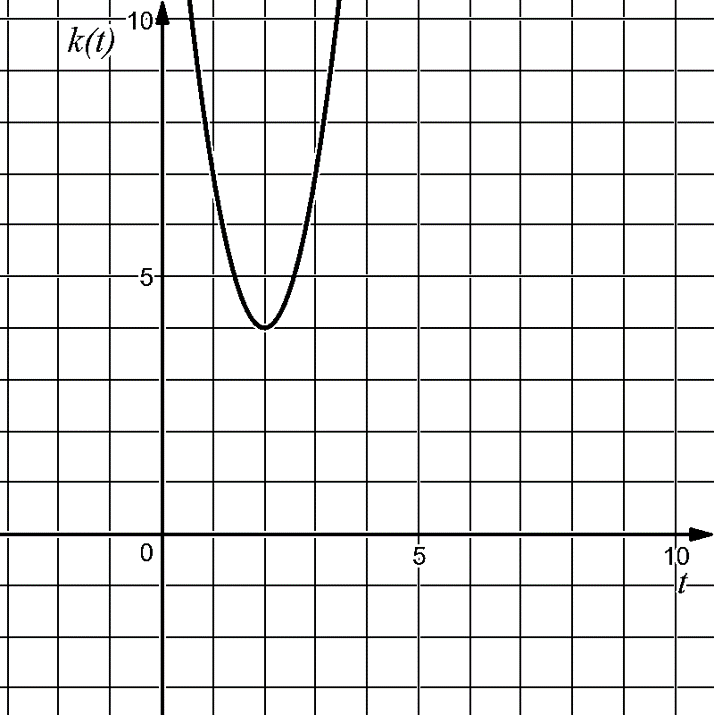
  6. Refer to the graph of \(k\) below.
    The graph of k of t is an upward-opening parabola. The vertex is at t equals 3 and k of t equals 4. The graph crosses the vertical axis above k of t equals 10 and increases on both sides of the vertex.
    Figure 1.5.7. Graph of \(k(t)\text{.}\)
    1. Evaluate \(k(2)\text{.}\)
    2. Solve \(k(t)\geq 7\text{.}\)
    3. Write an equation for \(k(t)\text{.}\)
    4. Use your equation from part ItemΒ 6.c to evaluate \(k(10)\text{.}\)
    5. Use your equation from part ItemΒ 6.c to solve \(k(t)=16\text{.}\) Use Desmos to check your answer.
  7. Dana is standing in a mall, with rows of stores stretching along both sides of a hall 30 meters wide. From Dana’s current location in front of Foot Locker, she wants to walk to Ross, a store on the opposite side of the hall and 50 meters down the hall.
    1. Draw a diagram showing Dana’s path and impose coordinates on the diagram.
    2. Write an equation for the line that describes the Dana’s path.
    3. Write parametric equations to describe Dana’s position at time \(t\text{,}\) if it takes her 10 seconds to walk from Foot Locker to Ross.
  8. Solve each equation or inequality algebraically.
    1. \(\displaystyle p^2-2p-15=0\)
    2. \(\displaystyle x^2+4=19\)
    3. \(\displaystyle v^2-12v-81=-9\)
    4. \(\displaystyle 2x^2-7x-49>0\)
    5. \(\displaystyle n^2-3n \geq 0\)
  9. Let \(n(x)=-x^2+4x-1\)
    1. Write \(n(x)\) in vertex form.
    2. Sketch the graph of \(n(x)\text{.}\)
    3. Solve \(n(x)=0\)
    4. Solve \(n(x)=-1\)
    5. Solve \(n(x) < 2\)
  10. Write a linear equation to model each function below.
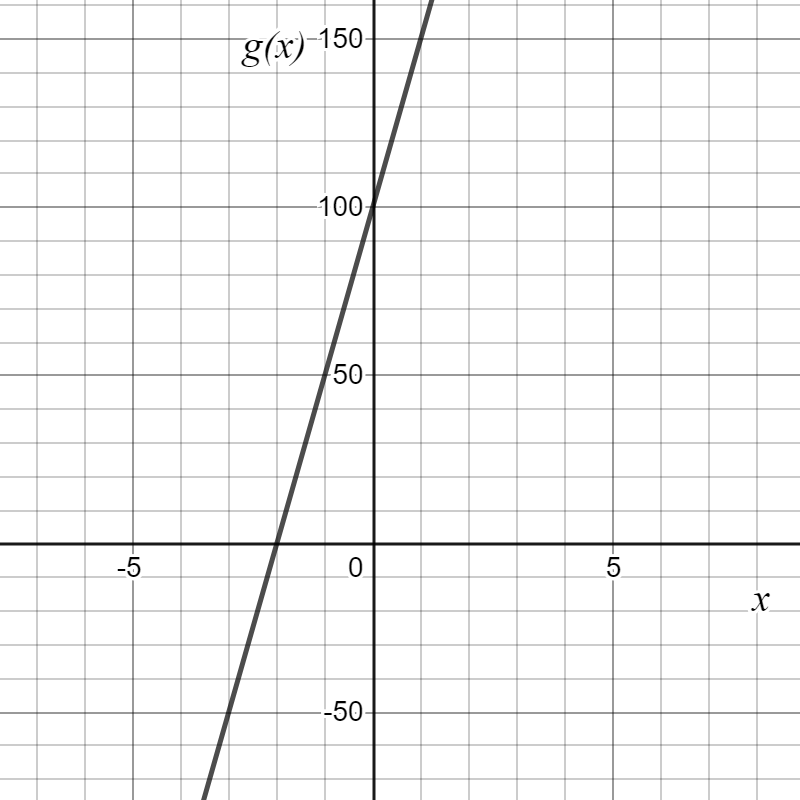
    1. \(g(x)\) shown on the graph below.
      The graph of g of x is a straight line with positive slope. The line crosses the vertical axis at g of zero equals 100 and increases rapidly as x increases. The x-intercept occurs at negative 2.
      Figure 1.5.8. Graph of \(g(x)\text{.}\)
    2. \(n(x)\) where \((-2, 1)\) and \((4, -2)\) lie on the graph of \(n(x)\text{.}\)
    3. \(q(x)\) defined by the table below.
      Table 1.5.9.
      \(x\) \(-1\) 0 1 2 3
      \(q(x)\) \(-\frac{7}{3}\) \(-2\) \(-\frac{5}{3}\) \(-\frac{4}{3}\) \(-1\)