In this course we will study many types of functions. In mathematics, functions are relations where each input produces exactly one output. Linear functions are used to describe patterns where the rate of change is constant, and will be the first type of function that we study.
Equations of lines are often written in slope-intercept form,
\begin{equation*}
y=mx+b
\end{equation*}
where \(m\) is the slope of the line and \(b\) is the vertical intercept (the point where the line crosses the vertical axis). The point-slope form of a line is also often useful and is written
\begin{equation*}
y-y_1=m(x-x_1)
\end{equation*}
where \(m\) is the slope of the line and \((x_1,y_1)\) is any point on the line.
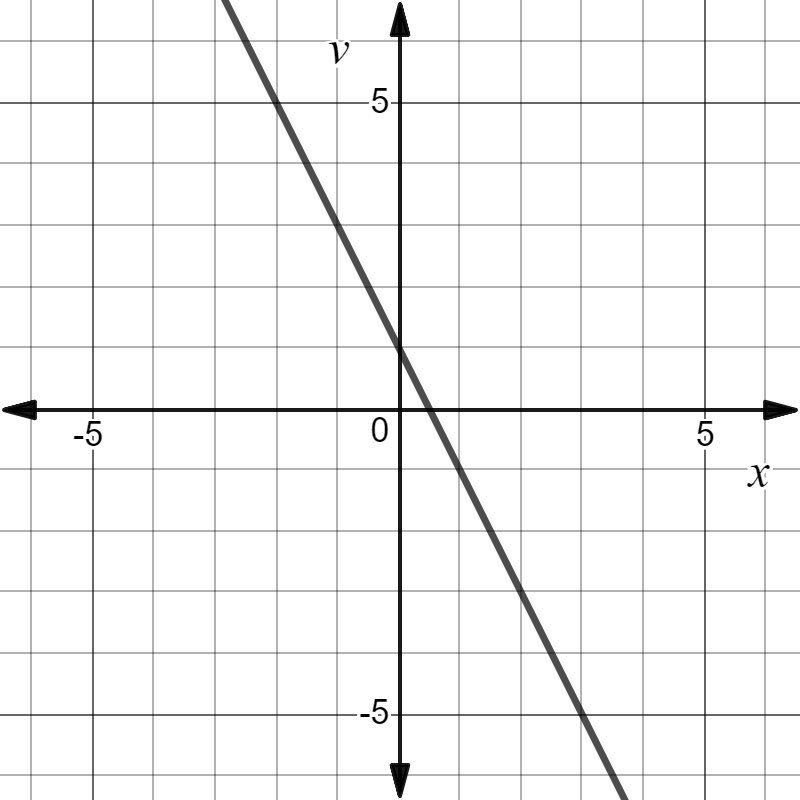
Graph the function on the domain \(-4 \leq x \leq 4\text{.}\) Be sure to label the \(x-\) and \(y-\)intercepts and the endpoints of the function on this domain.
Table Table 1.2.9 shows a number pattern. Fill in the blanks in the table, and make a graph of the values in the table. Then, write a function equation for \(f\text{.}\)
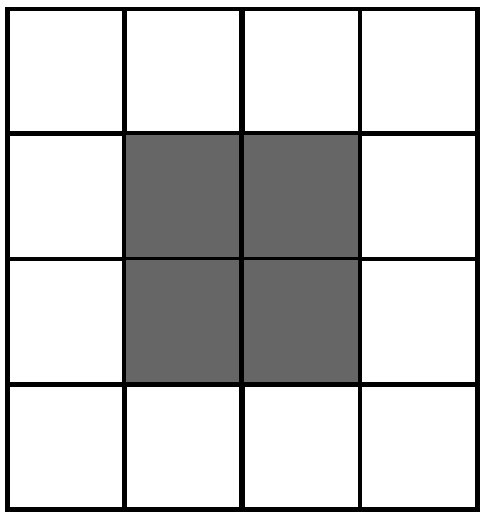
Nancy is a landscape artist. She specializes in square ponds surrounded by hand-painted tiles. Customers can order a pond in any size square, starting with sides measuring 2 feet, and available in one-foot increments thereafter (sides of 3 feet, 4 feet, 5 feet, etc.). The tiles are 1-foot square, and are placed edge-to-edge along the entire outer perimeter of the pond. An example pond is shown below.
If the side length of the pond is increased by 1 foot, how many more border tiles are needed? Explain why the number of tiles is increasing according to this pattern.
Your club wants to sell the doughnuts for $1 and make a profit of at least $0.45 on each doughnut. What is the minimum number of doughnuts you need to buy (and sell) in order for this to happen?
Stephanie is planting her summer garden. She purchased a sunflower plant from a nursery and planted it when it was 6 cm tall. After she planted it, the sunflower plant grew at a constant rate of 3 cm per day.
A worker at the nursery told Stephanie that her sunflower would reach its maximum height about 40 days after it was planted. What will the height be at that time?
Isabella is considering renting a car for one day to drive to an event in another city. Company A charges $20 per day plus $0.25 per mile, and Company B charges $25 per day plus $0.15 per mile.
Write a linear function equation that models the one day cost of renting a car from Company A, \(C_A\text{,}\) as function of \(m\text{,}\) the number of miles driven.
Write a linear function equation that models the one day cost of renting a car from Company B, \(C_B\text{,}\) as function of \(m\text{,}\) the number of miles driven.
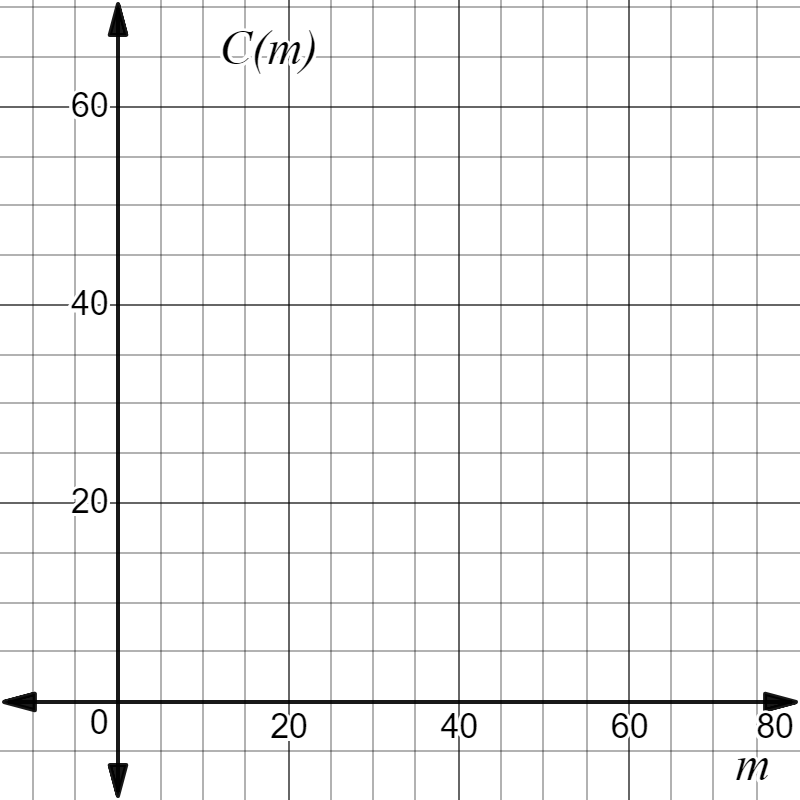
Graph \(C_A\) and \(C_B\) on the axes below. Use the graph to estimate the number of miles for which the cost for Company A is the same as the cost for Company B.
If the event Isabella is going to is a 60 mile round trip drive, which rental company should she choose? How much will she save by choosing that company?