Skip to main content
Contents Dark Mode Prev Up Next \(
\newcommand{\lt}{<}
\newcommand{\gt}{>}
\newcommand{\amp}{&}
\definecolor{fillinmathshade}{gray}{0.9}
\newcommand{\fillinmath}[1]{\mathchoice{\colorbox{fillinmathshade}{$\displaystyle \phantom{\,#1\,}$}}{\colorbox{fillinmathshade}{$\textstyle \phantom{\,#1\,}$}}{\colorbox{fillinmathshade}{$\scriptstyle \phantom{\,#1\,}$}}{\colorbox{fillinmathshade}{$\scriptscriptstyle\phantom{\,#1\,}$}}}
\)
Subsection 2.6 Functions and Inverse Functions Exercises
Refer to the function
\(g(x)=7x+2\text{.}\)
What are the domain and range of
\(g\text{?}\)
Let
\(h(x)=x^2+x+1\text{.}\) Find an algebraic expression for
\(g(h(x))\text{.}\)
Again using
\(h(x)=x^2+x+1\text{,}\) find an algebraic expression for
\(3g(x) - h(x)\text{.}\)
Find a function equation for the inverse function,
\(g^{-1}\text{.}\)
What are the domain and range of
\(g^{-1}\text{?}\)
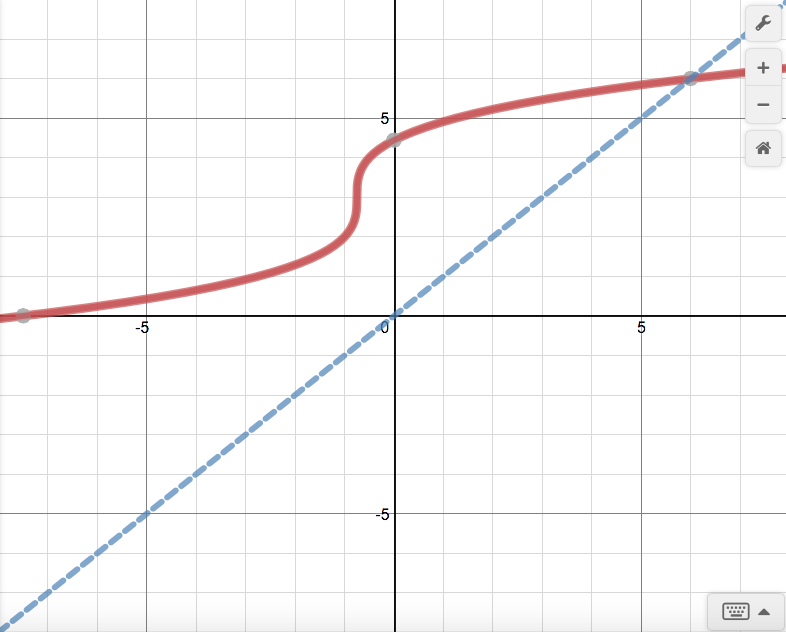
Refer to the graph of
\(R(x)\) in
Figure 2.6.13 . The diagonal line
\(y=x\) is included on the graph for reference. Note that the graph of
\(R(x)\) includes the points
\((-7.5,0)\text{,}\) \((-1,2)\text{,}\) \((0,4.5)\text{,}\) and
\((6,6)\text{.}\)
Figure 2.6.13.
What are the domain and range of
\(R\text{?}\)
Draw the graph of the inverse function,
\(R^{-1}\text{.}\)
What are the domain and range of
\(R^{-1}\text{?}\)
What are the domain and range of
\(f\text{?}\)
Find a function table for the inverse function,
\(f^{-1}\text{.}\)
What are the domain and range of
\(f^{-1}\text{?}\)
Let
\(A(x)=4(x-6)^{\frac{3}{2}}\text{.}\)
Write functions
\(b(x)\) and
\(c(x)\) so that
\(A(x)=b(c(x))\text{.}\)
What are the domain and range of
\(A(x)\text{?}\)
Find a function equation for the inverse function,
\(A^{-1}(x)\text{.}\)
What are the domain and range of
\(A^{-1}(x)\text{?}\)
On what interval(s) is
\(A\) increasing? On what interval(s) is
\(A\) decreasing?
Let
\(Z(x)=(x^2+4)^{\frac{1}{2}}\text{,}\) \(x \geq 0\text{.}\)
True or false: For all
\(x \geq 0\text{,}\) \(Z(x)=x+2\text{.}\) Explain your answer.
What are the domain and range of
\(Z(x)\text{?}\)
Find a function equation for the inverse function,
\(Z^{-1}(x)\text{.}\)
What are the domain and range of
\(Z^{-1}(x)\text{?}\)
Refer to
\(Q(x)=\sqrt[3]{x-3}\text{.}\)
What are the domain and range of
\(Q\text{?}\)
Let
\(U(x)=x^3\text{.}\) Find an algebraic expression for
\(U(Q(x))\text{.}\)
Find a function equation for the inverse function,
\(Q^{-1}\text{.}\)
What are the domain and range of
\(Q^{-1}\text{?}\)
The Jaguar XJ AWD loses value more rapidly than some of its competitors. From the initial purchase price of $76,700, an owner can expect the value of the car 5 years later to be $52,014.
What is the average dollar value decline per year during the first 5 years of ownership?
Use an exponential model produce a function that gives the value of the Jaguar in terms of the number of years,
\(t\text{,}\) since the car was new.
Use your model to predict the value of the Jaguar at 3 years old.
When will the value of the Jaguar decline to $30,000?
Simplify each expression below and write without negative exponents.
\(\displaystyle \frac{xy^7}{x^3y^4}\)
\(\displaystyle \left(\frac{2X^3}{-8X^4}\right)^2\)
\(\displaystyle \frac{8x^3(x^2)^8}{(-2x^6y)^2}\)