
Section 1.3 Linear Parametric Equations

Parametric equations are often used to keep track of the position of an object in motion. In this case, rather than having \(y\) as a function of \(x\text{,}\) usually we have \(x\) as a function of \(t\) (time), and \(y\) as a function of \(t\text{.}\)
Goals:
  • F: Be able to draw a diagram incorporating all of the important information in a given situation, and impose coordinates on the diagram.
  • L: Be able to model a situation involving linear motion with appropriate parametric equation(s) and interpret the solution.

Investigation 1.3.1.

The science quad at Julianโ€™s school measures 120 ft by 90 ft. Julian begins walking at a constant rate diagonally from the Northwest corner of the quad to the Southeast corner.
  1. The URL https://tinyurl.com/153ParaActivity shows Julianโ€™s path across the quad with coordinates imposed. Sketch his path below.
  2. What is the length of Julianโ€™s path across the quad?
  3. If Julian is walking at a speed of 5 feet per second, how long does it take him to walk the diagonal of the quad? In Desmos, move the slider for \(a\text{,}\) where \(a\) represents the number of seconds since Julian started walking, to see how Julian moves along his path. Label the starting and ending time on your graph.
  4. What are Julianโ€™s coordinates at time \(a=0\text{?}\) What are Julianโ€™s coordinates at time \(a=30\text{?}\) Label these times on your graph.
  5. What are Julianโ€™s coordinates at time \(a=20\text{?}\)
  6. At what time is Julian at the point \((20, 75)\text{?}\)
  7. So far this semester, we have worked with functions that are of the form \(y=f(x)\text{,}\) where \(y\) depends on \(x\text{.}\) Using this representation, Julianโ€™s path can be represented by the function \(y=f(x)=-\frac{3}{4}x+90\text{,}\) \(0 \leq x \leq 120\text{.}\)
    Julianโ€™s path can be represented by the parametric equations \((4t,-3t+90)\) where the \(x-\)coordinate of his position is given by \(x(t)=4t\) and the y-coordinate of his position is given by \(y(t)=-3t+90\text{,}\) \(0 \leq t \leq 30\text{.}\) What additional information does this representation of his path have that the first representation does not?

Example 1.3.1.

A woman is walking in a park. She begins at a point 30 meters west of the northwest corner of the playground, and walks in a straight line to a pond 60 meters north of the same corner of the playground.
  1. Draw a diagram showing the womanโ€™s path and impose coordinates on the diagram.
  2. Write an equation for the line that describes the womanโ€™s path.
  3. It takes the woman 20 seconds to walk to the pond. Write linear parametric equations to describe her position at time \(t\) seconds.
  4. It takes a different woman 30 seconds to walk the same path, but in the opposite direction. Write linear parametric equations to describe the second womanโ€™s position at time \(t\text{.}\)
Solution.
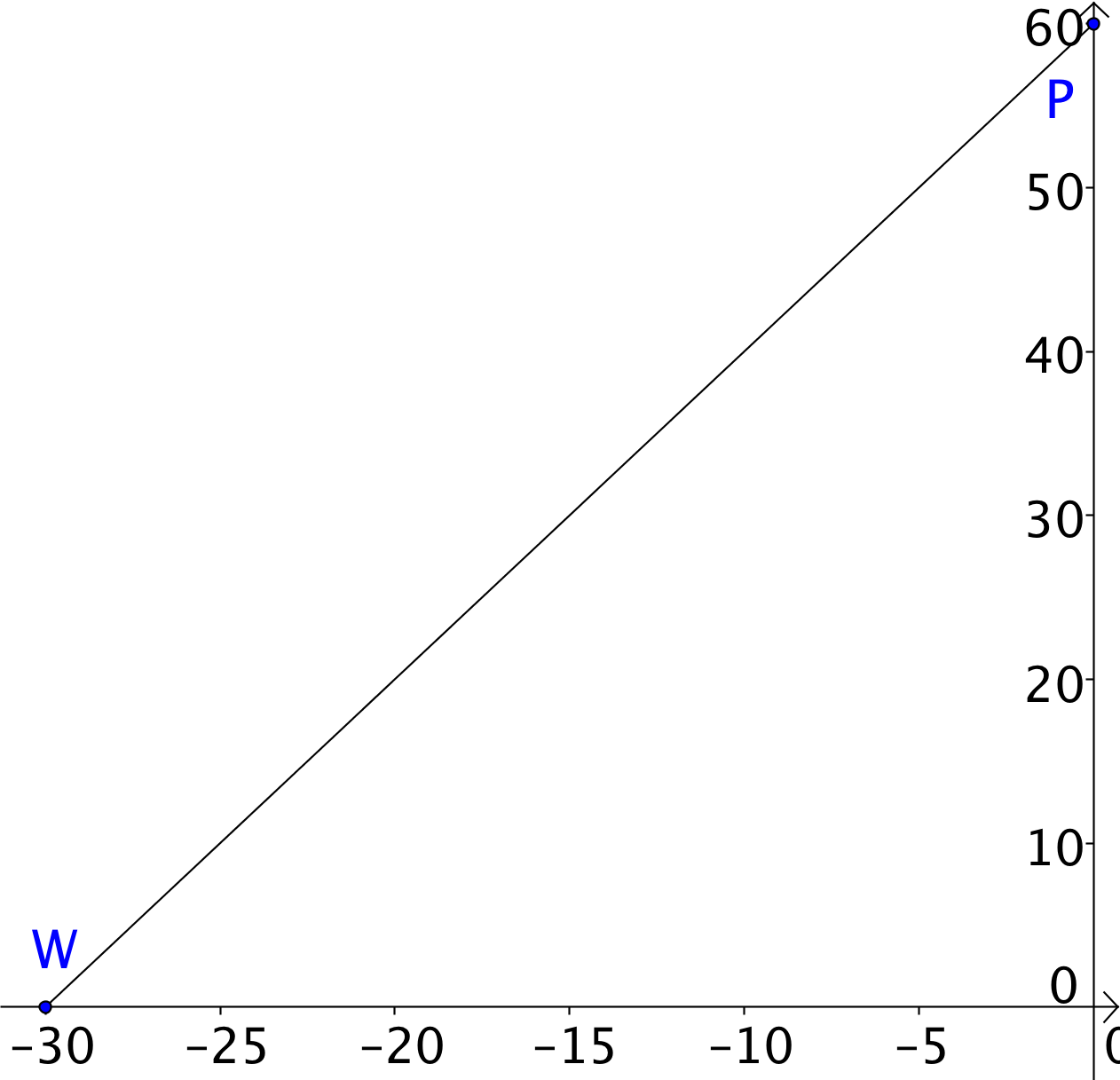
A coordinate-style diagram showing two labeled points: point W in the lower left region and point P in the upper right region, representing locations of a woman and another point in a park.
Figure 1.3.2. Diagram of a woman in a park.
The steps used to solve Exampleย 1.3.1 are outlined below: To solve Itemย 1, we draw Figureย 1.3.2, where \(W\) is the womanโ€™s starting position, and \(P\) is the pond. (Other diagrams are possible.)
To solve Itemย 2, find the equation passing through the two points \((-30,0)\) and \((0,60)\text{.}\) The slope is \(\frac{60-0}{0-(-30)}=2\text{,}\) and the \(y\)-intercept is \(60\text{,}\) so the equation is \(y=2x+60\text{.}\)
To solve Itemย 3, we are looking for two equations, \(x(t)\) and \(y(t)\text{.}\)
Step 1: Get values for \(t\text{,}\) \(x\text{,}\) and \(y\) at two points in time. In this problem, we know that at \(t=0\text{,}\) we are at point \(W\text{,}\) so \(x=-30\) and \(y=0\text{,}\) and at \(t=20\) seconds, we are at point \(P\text{,}\) where \(x=0\) and \(y=60\text{.}\)
Step 2: Get the \(x(t)\) linear equation. We are going to find the equation of a line where we treat \(t\) as the independent value and \(x\) as the dependent value. Notice that the slope will be \(\frac{\triangle x}{\triangle t}\text{.}\) So we have \(\frac{0-(-30)}{20-0}=\frac{3}{2}\text{,}\) and since at \(t=0\text{,}\) \(x=-30\text{,}\) then our equation is \(x(t)=\frac{3}{2}t-30\text{.}\)
Step 3: Get the \(y(t)\) linear equation. We are going to find the equation of a line where we treat \(t\) as the independent value and \(y\) as the dependent value. Notice that the slope will be \(\frac{\triangle y}{\triangle t}\text{.}\) We have \(\frac{60-0}{20-0}=3\text{.}\) At \(t=0\text{,}\) \(y=0\text{,}\) so our equation is \(y(t)=3t\text{.}\)
Step 4: Verify the solution. On Desmos, type in \((\frac{3}{2}t-30, 3t)\text{,}\) and set \(0 \leq t \leq 20\text{.}\) You should see the path from Figureย 1.3.2.

Problem 1.3.3.

Alberto is at the beach, and is hungry for a hot dog. Currently, he is standing at the waterโ€™s edge, 100 meters west of the boardwalk. Directly in front of him on the boardwalk, the nearest food vendor is his friend Carmen, who sells pizza. A hot dog vendor is 40 meters south of Carmenโ€™s pizza stand. Alberto plans to walk directly to the hot dog vendor.
  1. Draw a diagram showing Albertoโ€™s path and impose coordinates on the diagram.
  2. Write an equation for the line that describes the Albertoโ€™s path.
  3. Write parametric equations to describe Albertoโ€™s position at time \(t\text{,}\) if it takes him 90 seconds to walk from the water to the hot dog vendor.
