
Subsection 1.3 Linear Parametric Equations Exercises

  1. Write parametric equations for a point traveling along the line \(y=2x-6\text{,}\) such that at \(t=0\) the point is at the \(x\)-intercept, and at \(t=1\) the point is at the \(y\)-intercept.
  2. A volleyball court measures 18 meters by 9 meters. Jane takes 15 seconds to walk from one corner of the court to the diagonally opposite corner.
    1. Draw a diagram of the court and Jane’s path across the court, and impose coordinates on the diagram.
    2. Write parametric equations to describe Jane’s path.
  3. An object is moving along a line in the \(xy\)-plane so that at time \(t=0\text{,}\) it is at the point \((8,16)\) and at \(t=4\text{,}\) it is at the point \((0,-20)\text{.}\)
    1. Draw a diagram of the \(xy\)-plane showing the object’s position at time \(t=0\) and \(t=4\text{.}\)
    2. Write parametric equations \((U(t), V(t))\) to describe the position of the object at time \(t\text{.}\)
  4. Erwin is at an outdoor market. He walks in a straight line from a fruit stand at a point 65 feet due West of a fountain to a florist at a point 420 feet due North of the fountain. He walks at a constant speed of 5 feet per second.
    1. Draw a diagram showing the location of the fountain, the fruit stand, and the florist, and impose coordinates on the diagram.
    2. Write an equation describing Erwin’s path through the market.
    3. Write parametric equations for Erwin’s position \(t\) seconds after he begins walking.
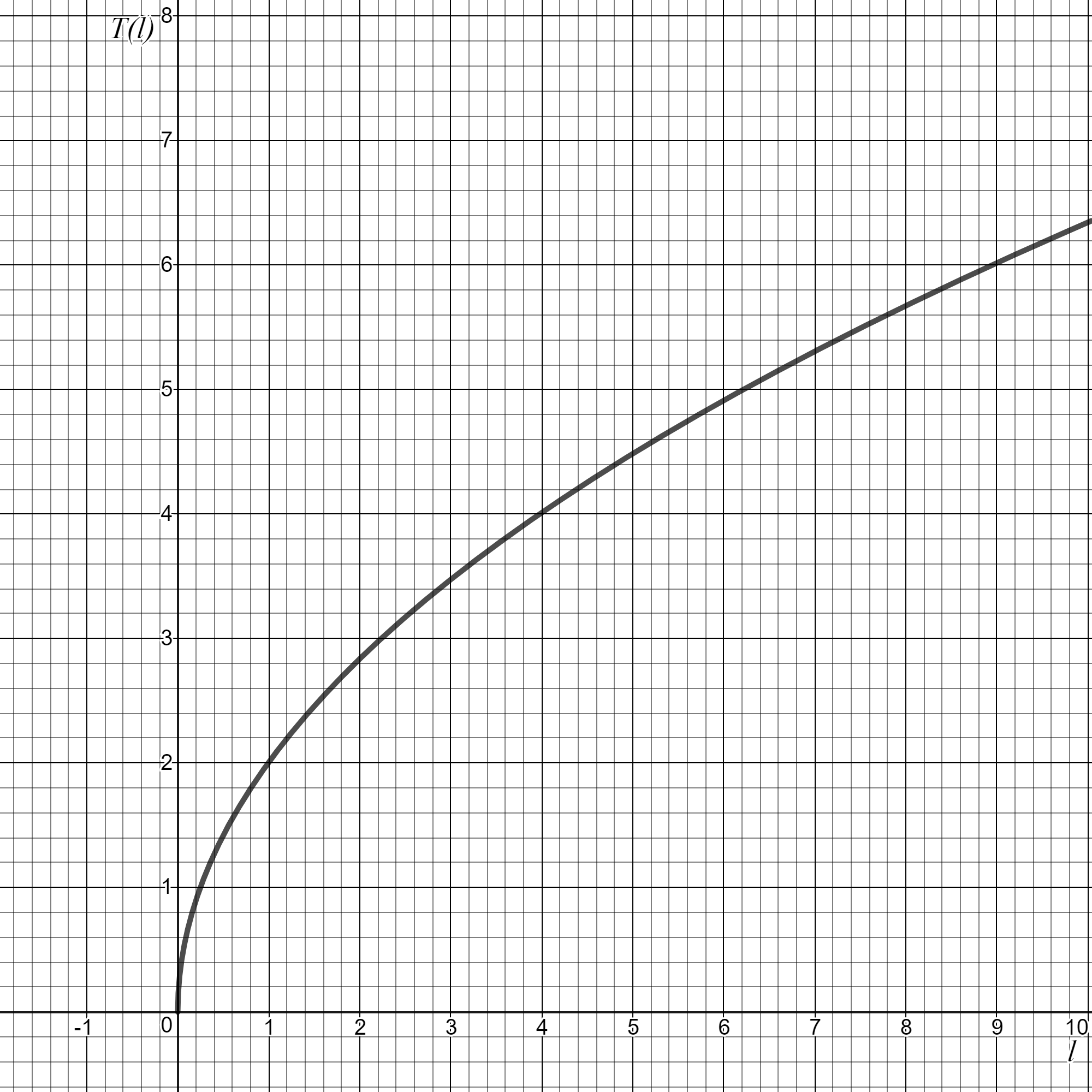
  5. The graph below shows the period of pendulum \(T\) (the time in seconds of one complete oscillation) as a function of the length of the pendulum, \(l\) (in meters).
    A graph of the function T of l. The curve begins at the origin and increases as l increases, rising quickly at first and then more slowly. The graph is increasing and concave down, with T(l) near 2 when l is about 1 and near 6 when l is about 9.
    Figure 1.3.4. Graph of the function T(l).
    1. Use the graph above to find the period (in seconds) of a pendulum of length 3 m.
    2. Use the graph above to find the length of a pendulum that has a period of 2.5 seconds.
    3. If the relationship between the length and period of a pendulum is given by the formula \(T(l)=2.006l^{\frac{1}{2}}\text{,}\) use the formula to find the period (in seconds) of a pendulum of length 3 m.
    4. Using the equation in ItemΒ 5.a find the length of a pendulum that has a period of 2.5 seconds.
  6. Mr. and Mrs. Jones both teach mathematics. By 1999, Mrs. Jones had taught 300 students, and has an average of 150 students each year. Mr. Jones began teaching his own classes in 1999, and has an average of 100 students each year.
    1. Write a function equation to estimate the total number of students Mrs. Jones has taught as a function of \(t\text{,}\) the number of years since 1999.
    2. Write a function equation to estimate the total number of students Mr. Jones has taught as a function of \(t\text{,}\) the number of years since 1999.

    3. In what year has Mrs. Jones taught 1000 more students than Mr. Jones?
  7. Evaluate each function for the indicated value or expression.
    1. \(r(t)=\sqrt{t^2-1}+1\text{,}\) \(r(-2)\)
    2. \(f(x)=x^3-2x\text{,}\) \(f(3)\)
    3. \(c(x)=x^2-1\text{,}\) \(c(x+2)\)
    4. \(d(t)=4t^{\frac{2}{3}}\text{,}\) \(d(8)\)
  8. Let \(f(x)=-x-2\text{,}\) \(g(x)=4x+1\text{,}\) \(h(x)=2(x-3)+1\)
    1. Evaluate \(h(-2)\)
    2. Evaluate \(f(0)\)
    3. Solve \(g(x)=-2\)
    4. Solve \(f(x)=g(x)\)
    5. Solve \(h(x) \leq -1\)
    6. Solve \(f(x) > 0\)
    7. Solve \(f(x) < h(x)\)
