Skip to main content
Contents Dark Mode Prev Up Next \(
\newcommand{\lt}{<}
\newcommand{\gt}{>}
\newcommand{\amp}{&}
\definecolor{fillinmathshade}{gray}{0.9}
\newcommand{\fillinmath}[1]{\mathchoice{\colorbox{fillinmathshade}{$\displaystyle \phantom{\,#1\,}$}}{\colorbox{fillinmathshade}{$\textstyle \phantom{\,#1\,}$}}{\colorbox{fillinmathshade}{$\scriptstyle \phantom{\,#1\,}$}}{\colorbox{fillinmathshade}{$\scriptscriptstyle\phantom{\,#1\,}$}}}
\)
Section 2.7 Logarithms
E: Be able to solve an equation with an unknown exponent.
E: Be able to model a situation with appropriate exponential equation(s) and interpret the solution.
E: Be able to use definition and properties of logarithms to rewrite expressions involving logarithms in different forms.
F: Be able to determine the inverse of a function given given in any form (graph, table, equation).
Logarithms are used to solve for unknown exponents in equations.
Definition 2.7.1 .
If \(x\) is a positive number then \(\log_{b}(x)\) is the exponent of \(b\) that gives x. That is
\begin{equation*}
y=\log_{b}(x)
\end{equation*}
if and only if
\begin{equation*}
b^{y}=x
\end{equation*}
The number \(b\) is called the base of the logarithm and is always greater than 0.
Definition 2.7.2 .
The
natural logarithm , written as
\(\ln x\text{,}\) is the logarithm with base
\(e\text{.}\)
Investigation 2.7.1 .
Use a calculator or Desmos to evaluate the following:
\(\displaystyle 1+\frac{1}{1!}\)
\(\displaystyle 1+\frac{1}{1!}+\frac{1}{2!}\)
\(\displaystyle 1+\frac{1}{1!}+\frac{1}{2!}+\frac{1}{3!}\)
\(\displaystyle 1+\frac{1}{1!}+\frac{1}{2!}+\frac{1}{3!}+\frac{1}{4!}\)
\(\displaystyle 1+\frac{1}{1!}+\frac{1}{2!}+\frac{1}{3!}+\frac{1}{4!}+\frac{1}{5!}\)
\(\displaystyle 1+\frac{1}{1!}+\frac{1}{2!}+\frac{1}{3!}+\frac{1}{4!}+\frac{1}{5!}+\frac{1}{6!}\)
Use a calculator or Desmos to evaluate the following:
\(\displaystyle \left(1+\frac{1}{1}\right)^1\)
\(\displaystyle \left(1+\frac{1}{2}\right)^2\)
\(\displaystyle \left(1+\frac{1}{3}\right)^3\)
\(\displaystyle \left(1+\frac{1}{4}\right)^4\)
\(\displaystyle \left(1+\frac{1}{100}\right)^{100}\)
\(\displaystyle \left(1+\frac{1}{1000}\right)^{1000}\)
Find the value of
\(e\) on your calculator or using Desmos. How does this compare to what you found above?
Problem 2.7.3 .
Compute the following
without using a calculator.
\(\displaystyle \ln(e^2)\)
\(\displaystyle \ln(e^6)\)
\(\displaystyle \log(10^3)\)
\(\displaystyle \log_2(2^{-2})\)
\(\displaystyle \ln(e^a)\)
Investigation 2.7.2 .
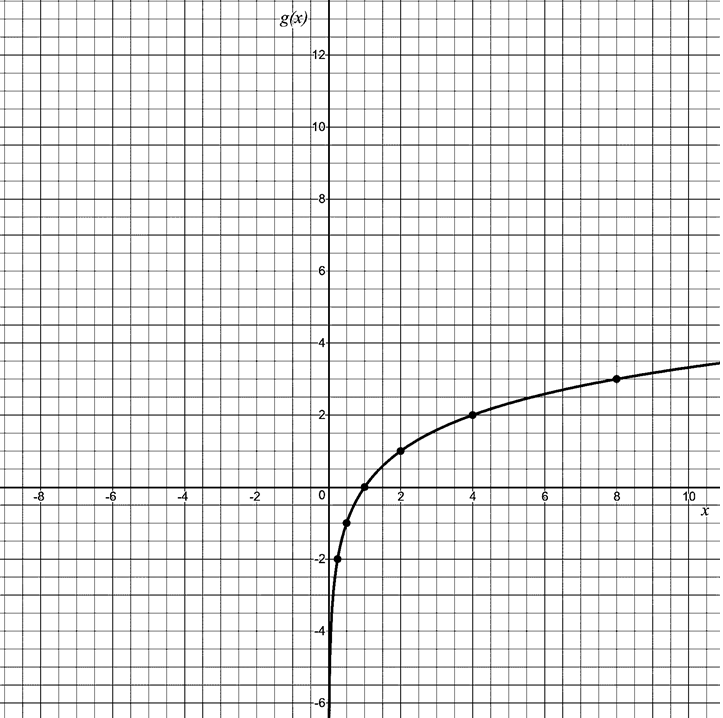
We will explore the relationship between log and exponential functions. A graph and table for
\(g(x)=\log_2(x)\) are given below.
Figure 2.7.4.
0.25
-2
0.5
-1
1
0
2
1
4
2
8
3
Table 2.7.5. Selected Values of \(g(x)=\log_2 x\)
Use the graph above to construct the graph of the inverse function,
\(g^{-1}(x)\text{.}\)
Use the table above to construct a table of the inverse function,
\(g^{-1}(x)\text{.}\)
What are the domain and range of
\(g(x)\text{?}\)
What are the domain and range of
\(g^{-1}(x)\text{?}\)
Explain why
\(g(x)=\log_2(x)\) is not defined for
\(x \leq 0\text{.}\)
For any base, the inverse of the exponential function
\(f(x)=b^x\) is
\(f^{-1}(x)= \log_b(x)\text{,}\) so that for positive
\(x\) values,
\(b^{\log_b(x)} = x\text{,}\) and for all real numbers,
\(\log_b(b^x)=x\text{.}\)
For example, the natural logarithm,
\(ln(x)\text{,}\) is defined on the domain of positive real numbers (
\(x>0\) ), and
\(e^x\) is defined on the domain of all real numbers. Since
\(\ln (e^x)=x\) and
\(e^{\ln x}=x\text{,}\) these functions are inverses of each other.
Problem 2.7.6 .
Use the definition of logarithm to solve the following equations.
\(\displaystyle 145=e^{2z}\)
\(\displaystyle 0=84-3 \cdot 10^{-x}\)
\(\displaystyle -4+3 \log_3{x}=5\)
\(\displaystyle 3 \ln{(x-1)}=8\)
Problem 2.7.7 .
The population of bacteria in a lab culture doubles every 15 minutes.
If there are initially 1000 bacteria in the culture, write a function,
\(P(t)\text{,}\) that gives the number of bacteria in the culture at time
\(t\) minutes.
How many bacteria will be present after 1 hour?
How long will it take the bacteria to reach 20,000?
Find an equation for the inverse function that gives the time,
\(t\text{,}\) as a function of the population,
\(P\text{.}\)